📬 Remix Reality Insider: Closing the Sim-to-Real Gap

Your monthly briefing on the systems, machines, and forces reshaping reality.
Thank you for being a subscriber to the Remix Reality Insider newsletter. We have moved to a monthly cadence to better surface signals and patterns. New editions will arrive on the last Monday of each month, starting today.
🛰️ The Signal
One pattern worth watching.
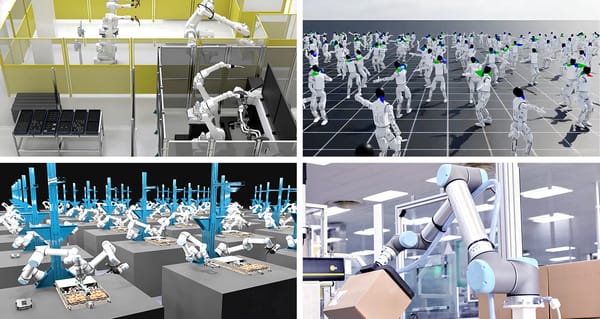
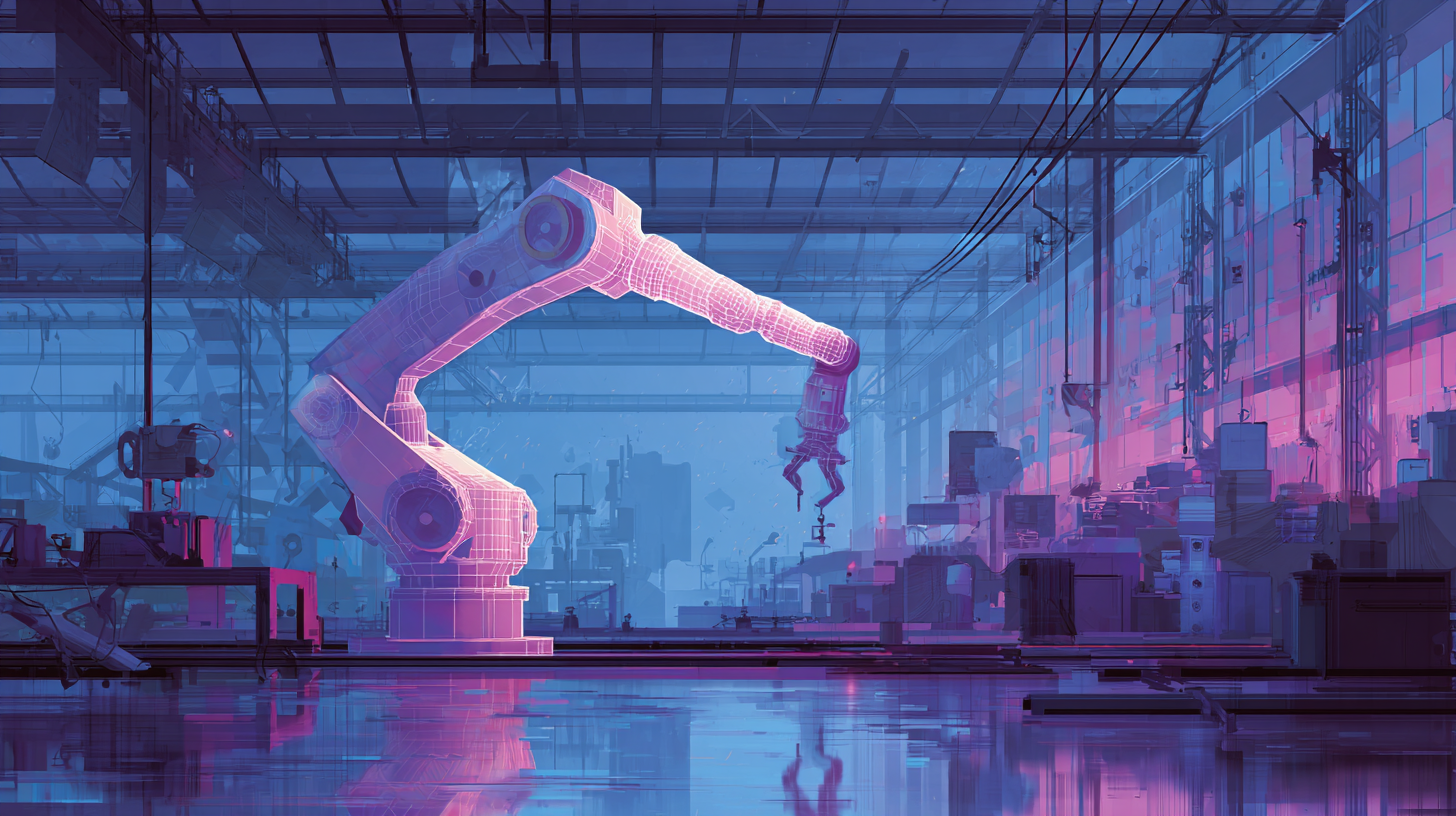
The gap between simulation and real-world deployment is starting to close in robotics. Instead of treating simulation as a rough approximation, companies are building systems where robots can learn, test, and validate tasks in software and then move into production with minimal adjustment.
This month's news surfaced signals like these:
- ABB is integrating NVIDIA Omniverse into RobotStudio to train industrial robots in physically accurate simulated environments, with claims of up to 80% faster setup and near real-world accuracy before deployment.
- Rhoda AI is taking a different approach, training robot foundation models on internet-scale video to build a prior understanding of motion and physics before adapting to real-world environments.
- Universal Robots and Scale AI are bringing training directly onto the factory floor, capturing synchronized motion, vision, and force data from robots in production to continuously improve models after deployment.
Why this matters: Getting robots to work in the real world has always been the hard part. As that gap narrows, more of the work moves into software. Systems can be trained ahead of time, then improved continuously once deployed, instead of relying on slow, manual setup.
🧠 Reality Decoded
A deeper look at what matters.
GTC this month in San Jose made one thing clear: Robotics is moving toward a full-stack platform approach, and NVIDIA is positioning itself at the center of it.
“Physical AI has arrived — every industrial company will become a robotics company,” said Jensen Huang at the event. That framing showed up not just in the keynote, but across the stack NVIDIA is building, from simulation and synthetic data to models and deployment infrastructure.
Three takeaways from GTC:
- Robotics is becoming a platform business: NVIDIA is building the infrastructure layer for robotics, spanning compute, simulation, and models. More than 2 million robotics developers are now building on its platform, signaling where gravity is forming.
- Ecosystems are becoming the moat: NVIDIA is working with companies across industrial, humanoid, and healthcare robotics, including ABB, FANUC, KUKA, Figure, Medtronic, and Universal Robots. It is also connecting into broader AI ecosystems through integrations with Hugging Face, linking robotics to a much larger base of AI builders.
- The stack is coming together: With Cosmos for simulation and synthetic data, Isaac for training, and GR00T for robot skills, NVIDIA is aligning the full lifecycle from development to deployment. The goal is to reduce friction between simulation and real-world operation.
Key Takeaway:
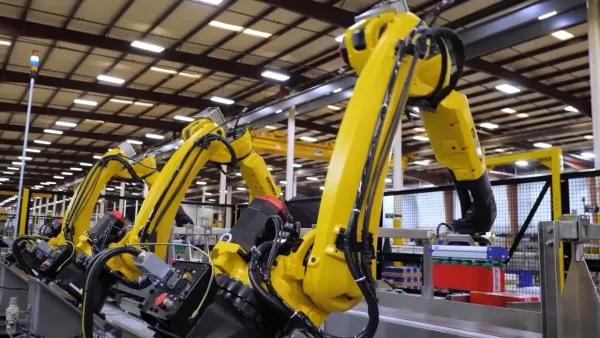
Robotics is starting to look less like a hardware problem and more like a system. The advantage comes from how well training, simulation, and deployment are connected, not just from the robot itself.
📡 The Radar
Your monthly scan across the spatial computing stack.
🚗 Wayve Raises $1.5B to Scale End-to-End Autonomous Driving Platform
- Wayve closed a $1.2 billion Series D, part of $1.5 billion secured to support the commercial rollout of its autonomy platform.
- Why this matters: This raise reflects alignment across automakers, hyperscalers, chipmakers, and mobility platforms around Wayve’s end-to-end AI approach.
🏪 Meta Commits to Permanent Fifth Avenue Flagship to Showcase Wearable Tech
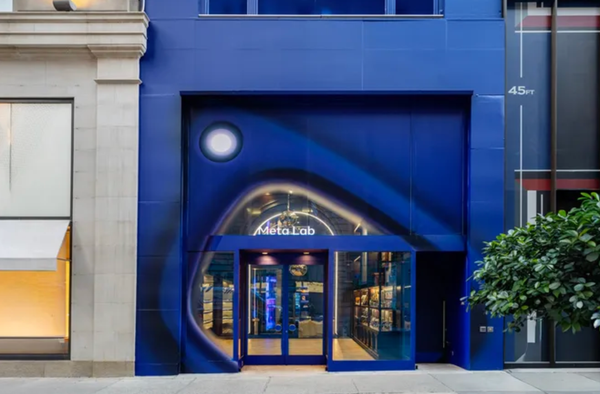
- Meta has signed a 10-year lease to make its Fifth Avenue Meta Lab NYC location permanent.
- Why this matters: A 10-year lease suggests Meta is betting that hardware needs a physical retail presence to drive adoption, not just online distribution.
🤖 Serve Robotics Expands Partnerships as Fleet Reaches 2,000 Robots
- Serve reported $2.7 million in full-year 2025 revenue, about a 46% increase year over year, and raised its 2026 revenue outlook to approximately $26 million.
- Why this matters: By adding new partners and building revenue streams beyond delivery fees, from software to healthcare robotics, the company is widening how autonomous robots generate value across its platform.
🏭 RoboForce Raises $52M for Physical AI Platform for Industrial Robotics
- RoboForce raised $52 million in an oversubscribed funding round, bringing its total funding to $67 million.
- Why this matters: RoboForce’s approach means each deployment feeds the next, turning operations into a compounding learning system rather than one-off automation.
💍 Oura Acquires Doublepoint and Shifts Gesture Tech In-House
- Doublepoint said Oura has acquired the company and that its future work will move into Oura products.
- Why this matters: This looks like a way for Oura to expand what its products can do by bringing Doublepoint’s gesture tech in-house.
👓 VITURE Raises Another $100M, Tops $200M in Six Months
- VITURE closed a $100 million financing round on February 26, 2026, led by Legend Capital, affiliated with Lenovo, bringing total capital raised in six months to over $200 million.
- Why this matters: Two $100 million rounds in six months give VITURE room to operate aggressively. Pair that with expanded retail distribution, and the company appears focused on scaling sales, not just shipping new models.
🚁 VR Headset Training Initiative Targets Helicopter Safety in Nepal
- EASA, Airbus Helicopters, and Loft Dynamics launched a VR-based training program aimed at improving pilot readiness in Nepal’s demanding flight environment.
- Why this matters: Bringing VR simulator training to Nepal gives helicopter pilots a way to practice mountain flying and emergency situations in a controlled environment.
🌍 Dexterity World Model Speeds Up Robot Decisions on NVIDIA Hardware
- Dexterity’s Foresight is a world model that builds a real-time view of physical environments, allowing robots to evaluate geometry, contact, and stability before taking action.
- Why this matters: Faster perception means the robot can act on a current view of the world instead of an outdated one, which is critical when handling many objects in real time.
🌐 8th Wall Opens the Technology Behind Its WebAR Platform
- The company shut down its hosted WebAR platform on February 28, 2026 and moved the technology to a public project at 8thwall.org.
- Why this matters: Open-sourcing the engine could change the trajectory of the browser itself. If developers can evolve the framework as web standards shift, the browser could become a permanent home for immersive experiences rather than just a place to launch them.
🛠️ Intrinsic Moves Under Google to Expand Industrial Robotics Platform
- Intrinsic has become part of Google to scale its robotics software platform across enterprise manufacturing environments.
- Why this matters: Intrinsic built the tooling layer for industrial robotics, but plugging directly into Gemini, Cloud, and DeepMind gives it access to the research pipeline and infrastructure needed to move faster and to push advanced AI into production environments at scale.
🗺️ Niantic Spatial Teams With Coco Robotics on Navigation Infrastructure for Delivery Robots
- Niantic Spatial formed a strategic partnership with Coco Robotics to provide spatial AI and visual positioning technology for the company’s delivery robots.
- Why this matters: Visual positioning is emerging as a critical navigation layer for robots operating in dense urban environments where satellite signals break down.
- ZaiNar raised more than $100 million at a valuation exceeding $1 billion as it launched a platform for Physical AI that turns existing wireless networks into a location sensing system.
- Why this matters: If existing 5G and WiFi networks can become location sensing systems without new hardware, that flips wireless infrastructure from connectivity pipes into spatial infrastructure. Turning sunk network costs into a real-time positioning layer is a structural shift.
📷 Harbinger Acquires Phantom AI and Secures ADAS Licensing Deal With ZF
- Harbinger has acquired autonomous driving company Phantom AI and finalized a licensing agreement with ZF’s passenger car ADAS division.
- Why this matters: Harbinger is moving up the stack. This move is not just about building electric trucks, but owning the driver-assistance layer inside them. And by supplying that same software into the passenger car market through ZF, it shifts its business from just a vehicle maker to a software player.
🌀 Tom's Take
Unfiltered POV from the editor-in-chief.
We’re starting to see the rise of robot theater.
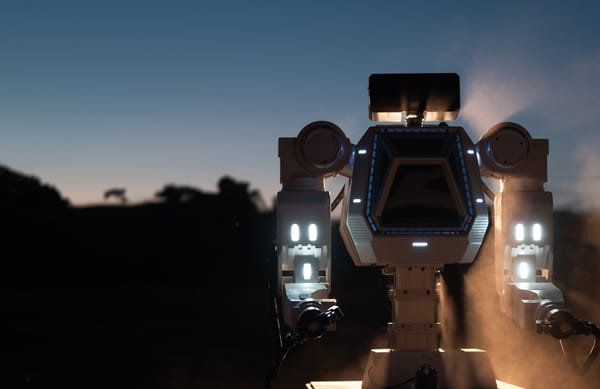
Scroll any social feed, and you’ll see robots doing kung fu, dancing, and doing other tricks for the camera. Robots are being staged, choreographed, and turned into something people can watch and share. This was especially the case at GTC 2026, where nearly every after-party I attended had at least one robot put to work for entertainment purposes.
Robot theater plays an important role in helping this technology cross from industry into the mainstream. Before robots become useful at scale, they need to become familiar. Performance creates visibility. It makes robots feel less intimidating, more approachable, even friendly. It turns them from industrial machines into something people can actually relate to.
Robot theater also presents a new opportunity for marketers. It expands what experiential marketing can look like and gives physical retail a new kind of draw. In stores and at events, these systems can bring people in, keep them there longer, and create moments that can go viral on social media.
Brands are already starting to experiment here. It wasn't too long ago that Cheetos leaned into the spectacle with its hands-free robotic activation at SXSW. Disney has brought its Frozen character to life with a robotic character that moves through space and interacts with guests as living IP. And Nike has experimented with choreographed robotic arms in store for a recent LeBron launch.
It’s easy to look at a robot dancing and dismiss it as a gimmick. Don’t. This has the potential to become a new category and reshape how brands show up in the physical world.
🧵 The Throughline
Three emerging themes shaping what's next.
- Robotaxis plug into the platform, not the other way around
Uber is expanding its robotaxi strategy through partnerships with Wayve, Nissan, and Zoox, bringing autonomous vehicles onto its network rather than building them in-house. That lets Uber act as the demand layer while others supply the vehicles and driving systems. As robotaxis scale, this model positions Uber as the interface riders use, regardless of who builds or operates the underlying autonomy stack. - Giving robots better eyes changes how they work
Better vision is what allows robots to operate safely and consistently outside controlled settings. Looper is packaging spatial perception, mapping, and navigation into a single camera system that can be deployed across different robots, while RealSense is showing that reliable movement in human environments depends on continuous depth sensing and spatial awareness. As spatial understanding improves, robots can handle more variability, work closer to people, and take on tasks that were previously too unpredictable to automate. - Digital twins move work before hardware exists
NORD is using digital twins and virtual commissioning to validate systems before they hit the factory floor, while Synopsys is enabling teams to test up to 90% of vehicle software before hardware is built. More of the work is happening in software first. That shortens development cycles, reduces costly rework, and lets systems arrive closer to production-ready.
Know someone who should be following the signal? Send them to remixreality.com to sign up for our free newsletter.
📬 Make sure you never miss an issue! If you’re using Gmail, drag this email into your Primary tab so Remix Reality doesn’t get lost in Promotions. On mobile, tap the three dots and hit “Move to > Primary.” That’s it!
🛠️ This newsletter uses a human-led, AI-assisted workflow, with all final decisions made by editors.