🔓 Remix Reality Insider: Teaching Machines to See

Your premium drop on the systems, machines, and forces reshaping reality.
🛰️ The Signal
This week’s defining shift.
Vision-language models (VLMs) are the next frontier for AI, giving machines the ability to understand what they see.
VLMs combine what the camera sees with AI to add context. This turns raw visual input into information that can be applied in practical ways, from managing inventory to helping robots adapt in the home.
This week’s spatial computing news surfaced signals like these:
- Starbucks is scaling visual AI for inventory, turning messy store shelves into structured data that informs operations.
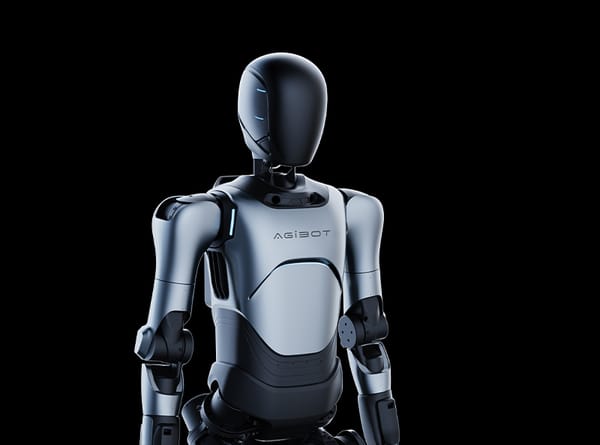
- Figure’s Helix uses vision-language action models to teach dishwashing to its humanoid robot F 02, a household task where robots must adapt in real time.
- SwitchBot AI Pet combines visual and emotional recognition with embodied AI, showing that companionship depends on context.
- Orchard Robotics is raising $22M to expand its FruitScope Vision System, giving farmers a complete picture of their crops for better decisions.
Why this matters: VLMs mark a step from AI that mostly lives behind screens to systems that work in the physical world. By linking vision with language, they make it possible for technology to take on roles in homes, stores, and cities in more reliable ways.
🧠 Reality Decoded
Your premium deep dive.
Waymo’s expansion is putting its autonomous vehicles into some of the toughest driving conditions in the U.S. The company is preparing to launch in Seattle and Denver and has begun testing in New York City. Seattle brings heavy rain, Denver adds altitude and snow, and New York challenges the system with dense urban streets.
These cities build on an existing footprint that already includes Phoenix, San Francisco, and Los Angeles through the Waymo app, as well as Austin and Atlanta through Uber. The rollout shows that Waymo is expanding beyond fair-weather cities into markets where rain, snow, and dense traffic will test how resilient its systems really are.
Key Takeaway:
Robotaxis can’t roll out in every city at the same time. Each place has its own weather, traffic, and road layout, and vehicles need to be tested and prepared for those specifics. Expansion depends as much on learning local conditions as on the technology that powers the cars.
📡 Weekly Radar
Your weekly scan across the spatial computing stack.
🍔 Circus SE and Secura Partner to Deploy Autonomous Meal Robots
- Circus SE will launch its CA-1 autonomous meal robot in partnership with Secura, beginning at Ingolstadt’s Quartier G innovation hub.
- Why this matters: Facility services already manage kitchens, logistics, and labor. Dropping autonomous food robots into that stack makes real commercial sense.
🚗 Isuzu to Open Japan’s First Autonomous Truck Test Course by a Commercial Vehicle Maker
- Isuzu will open a 190,000 m² test site in Hokkaido in 2027 to trial its Level 4 autonomous trucks and buses in controlled, complex traffic scenarios.
- Why this matters: Closed-course environments that mirror real-world roads are key to accelerating autonomy. Facilities like this give Isuzu a controlled edge in preparing its models for public deployment.
🏠 Horizon Update Brings New Immersive Home and Expanded Horizon Central to Meta Quest
- Meta Quest’s Horizon OS update debuts a new Immersive Home and retires older environments.
- Why this matters: The home experience is critical to all Meta Quest users, and so updates to this environment are core to the headset user experience. The introduction of a new Immersive Home makes this update a big deal.
🏥 zSpace and The Glimpse Group Launch Virtual Trainer for Medical Assisting Skills
- Virtual Trainer enables students to practice 33 certified medical tasks in a virtual environment.
- Why this matters: Virtual training that’s safer, repeatable, and scalable offers a practical solution to long-standing challenges in healthcare education. It allows students to build skills at their own pace while easing pressure on physical resources.
🧊 3D Gaussian Splats Added to glTF with Support from Khronos, OGC, and Niantic
- Khronos and partners added 3D Gaussian splat support to glTF using two new extensions.
- Why this matters: Standardizing Gaussian splats in glTF gives developers a portable, efficient way to use photorealistic 3D capture across tools, engines, and platforms, without reinventing the pipeline.
🛠️ Tripo 3.0 Launches With New Features for Scalable 3D Creation
- Tripo debuts its most advanced 3D foundation model, adding precision texture control, segmentation, and multi-modal input to its AI-native platform.
- Why this matters: Tripo’s focus on the ecosystem is key, not just making its foundation model stronger through open-source contributions, but making it usable through plugins that meet creators where they already work.
☕ Starbucks Activates Visual AI for Inventory in North America
- Starbucks is finalizing a North American rollout of a visual AI-driven system that digitizes in-store inventory tracking.
- Why this matters: Starbucks is putting computer vision and AR into daily retail operations at scale, a clear signal that spatial AI is moving from pilot to platform. It shows how major brands are starting to rebuild physical operations around real-time, spatial data.
🍽️ Helix Adds Dishwasher Loading to Figure 02’s Skillset
- Helix, the model running on Figure 02, learned to load dishwashers using only new data with no algorithm update needed.
- Why this matters: Figure keeps showing how Helix, its robot brain, can scale through learning. This generalized approach lets the system take on new tasks without new code or model changes.
🥤 Coca-Cola Augmented Reality Campaign Turns You Into a Star Wars Hologram
- Fans can scan special-edition cans to unlock a Star Wars-themed AR experience.
- Why this matters: Coca-Cola has long been a pioneer in the use of augmented reality with its products. This collaboration with Disney shows how linking AR to packaging can boost engagement while turning consumers into content creators, creating and sharing content featuring the brand and the experience.
♿ Irvine Deploys Daxbot Robots to Audit Sidewalk Accessibility
- Autonomous units will survey sidewalks and curb ramps to support the city's ADA compliance review.
- Why this matters: A lot of the focus on robots is on what they can do, but it's also about what information they can collect. This is a great example of using in-world sensors as physical AI to better understand our environment.
🌀 Tom's Take
Unfiltered POV from the editor-in-chief.
Headsets today do a good job of connecting people who aren’t in the same room. But are we leaving the people right next to us behind? The focus of these devices has been mainly on telepresence, but the real breakthrough may come from sharing a new reality with the people already in the room.
MR headsets are great for meeting, collaborating, or playing with friends miles away, but they still struggle to include the people sitting beside you. Unless your friend owns a headset and brings it over, or you are a family that bought more than one device, the virtual experience in a shared physical space is mostly a solo one.
Right now, the only way to engage with others who are in the room with you is by casting your view to a TV and having them shout at you between realities. That breaks immersion and turns shared time from something social into more of a spectacle. Ironically, the same technology that connects people across distance falls short when everyone is in the same room.
OEMs could change this by offering bundles of two or four devices that unlock group experiences. Imagine families going to a virtual movie together, friends watching a live sports event from the couch, or neighbors taking game night to the next level when they come over. These bundles would need to be affordable and centered on content that brings people together. The challenge is cost, but solving for this could be the step that finally gets more people into headsets.
🔮 What’s Next
3 signals pointing to what’s coming next.
- Robots as Large-Scale Sensors
Robots aren’t just being built to move or deliver. They are increasingly being used to see and record the world around us. Orchard Robotics is giving farms vision across every row, tree, and vine. Its FruitScope system mounts cameras on vehicles to scan crops in detail and turn images into usable data. In Irvine, Daxbot is deploying mobile robots to measure sidewalks and curb ramps for ADA compliance, cutting years of manual review down to weeks. In both cases, robots are being used to collect information at a scale and speed that people cannot. - 3D Powers Immersive Content Creation
Immersive platforms depend on 3D, and the tools to make and share it are advancing fast. Tripo 3.0 brings new precision and speed to asset generation, adding features like texture control, segmentation, and multimodal input while plugging directly into Unity and Blender. At the same time, Khronos and partners have added Gaussian splat support to glTF, giving developers a portable standard for storing and streaming photorealistic 3D capture. These updates show that 3D is the backbone of immersive content creation, with AI lowering the barriers to production and standards ensuring assets can move freely across platforms. - Smartglasses Focus on Multi-Use
Smartglasses are being built as all-purpose devices to fit into every facet of our daily lives. Instead of targeting one function, like music or gaming, companies are combining communication, media, and productivity into a single device. Reliance Jio introduced JioFrames with features for photos, calls, music, real-time translation, and access to an AI assistant. VITURE raised $100 million to expand its Luma XR lineup, which includes models for entertainment and work. The push toward multi-use shows how companies see these devices as smartphone replacements when they are ready.
🔓 You’ve unlocked this drop as a Remix Reality Insider. Thanks for helping us decode what’s next and why it matters.
📬 Make sure you never miss an issue! If you’re using Gmail, drag this email into your Primary tab so Remix Reality doesn’t get lost in Promotions. On mobile, tap the three dots and hit “Move to > Primary.” That’s it!