🔓 Remix Reality Insider: Trucking Meets Autonomy


Your premium drop on the systems, machines, and forces reshaping reality.
🛰️ The Signal
This week’s defining shift.
Autonomous freight is entering the fast lane.
Autonomous freight is still deep in trials, with companies testing next-generation hardware and purpose-built trucks on closed tracks as they get ready for wider rollout. Safety is still the focus, with systems proving reliability in controlled environments while the hardware shows it can scale. Customer demand is growing, and the first commercial freight operations are planned for 2026, marking a careful shift from experimentation to deployment.
This week’s news surfaced signals like these:
- Aurora opened a new 600-mile autonomous trucking route between Fort Worth and El Paso. Its next-generation hardware cuts costs in half and doubles lidar range, positioning it for fully driverless operations in 2026.
- Volvo and Waabi completed integration of the Waabi Driver into the production-ready Volvo VNL Autonomous, marking the start of large-scale testing and a new benchmark for purpose-built freight automation.
- International Motors and PlusAI are building self-driving trucks directly on the factory line, embedding autonomy at the point of manufacture instead of retrofitting later. The collaboration with NVIDIA signals deep alignment between automakers, chipmakers, and AI developers.
Why this matters: Autonomous freight is getting close to the next phase. Trials are still underway, but safety results are improving, and real demand is waiting. The work now is to prove that these systems can run every day, at scale, in real conditions.
🧠 Reality Decoded
Your premium deep dive.
The humanoid home robot has arrived. This week, 1X opened preorders for NEO, a soft-bodied humanoid designed for everyday life. At $20,000 USD, it’s the first consumer-available robot of its kind. NEO can talk, tidy your living room, do your dishes, or even fold your laundry. Early U.S. consumers are expected to receive their NEO as early as next year.
Here’s what makes NEO different:
- Soft design and safety: At 5'6", NEO has a human-scale form wrapped in a flexible polymer shell that is meant to make it both approachable and safe. It features a machine-washable suit and shoes and comes in three different colors.
- Embodied AI for the home: NEO doesn’t rely on scripted routines. Redwood enables it to learn tasks, refine them, and apply those learnings in new contexts, moving closer to the adaptive intelligence we’ve long imagined for home robots. It can walk, sit, stand, kneel, and climb stairs right out of the box.
- Human-in-the-loop support: When needed, trained 1X Experts can be invited into the robot to help train NEO remotely on new tasks. Users will be notified when an expert is live through visible consent indicators on the robot's ears and access privacy controls in the companion mobile app.
Key Takeaway:
This marks a real milestone for humanoid robots and for 1X. It will be a true test as to the current limits of humanoids in real world scenarios. It will also start to uncover the social contracts we will need to start to build around living with a robot and having a robot in our home.
📡 Weekly Radar
Your weekly scan across the spatial computing stack.
👟 Nike Unveils Robotics-Powered and Neuroscience-Informed Footwear as Part of Major Innovation Push
- Project Amplify and Nike Mind are two of four new innovation platforms introduced under Nike’s unified Sport Offense strategy.
- Why this matters: Nike has been an early mover in wearable innovation, having kicked off the fitness tracker movement with the Nike FuelBand over a decade ago. This new structure is sure to help the already innovation-forward company move faster with the latest advancements in sensors and robotics.
🤿 Nauticus Locks In $250M to Expand Into Deep-Sea Mineral Exploration
- Nauticus secured a $250 million equity credit line to fund acquisitions and expand into deep-sea mineral exploration.
- Why this matters: Nauticus is building both the tools and the strategic path to compete in high-stakes deepwater environments and positioning itself to shape the future of subsea mineral access.
🏥 Moxi 2.0 Brings Smarter AI to the Hospital Hallway
- The updated Moxi platform features new AI infrastructure, custom-built hardware, and expanded compute through NVIDIA’s IGX Thor.
- Why this matters: Diligent Robotics is using the data, edge cases, and feedback from version 1.0 as the foundation to give Moxi an upgrade that makes it more useful and a robot that can scale.
👷 Arc 3 Headset Brings AI-Powered Voice Control to Frontline Work
- Arc 3 introduces a lighter design and natural language controls for hands-free use in industrial settings.
- Why this matters: RealWear has been a leader in industrial eyewear and software for sectors like automotive, oil and gas, and manufacturing. With Arc 3, they’re taking those learnings and a cue from where consumer eyewear is heading with AI glasses to introduce a new solution built for new environments.
👓 Magic Leap and Google Extend AR Alliance With Glasses Prototype Reveal
- Magic Leap and Google signed a three-year agreement to co-develop display technology for AR glasses.
- Why this matters: This marks the next big chapter for what was once a leader in AR glasses. Magic Leap is shifting from building its own products to applying its technology and experience to strengthen the broader ecosystem growing around it.
🛸 DroneOps Brings Live 3D Airspace Monitoring to Apple Vision Pro
- DroneOps delivers immersive airspace visibility on Apple Vision Pro, using live aerial data from Hidden Level.
- Why this matters: Vision Pro’s spatial perspective reveals aerial data in an entirely new light, turning raw flight patterns into insights you can see and respond to in real time.
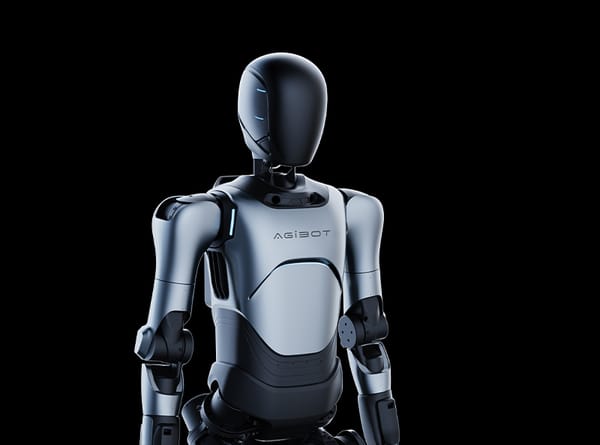
🤖 AgiBot’s LinkCraft Turns Everyday Videos into No-Code Robot Performances
- LinkCraft turns human motion videos into robot performances using AI-based motion capture and imitation learning.
- Why this matters: LinkCraft shows just how powerful vision-language-action models can simplify high-effort tasks. This no-code approach is especially useful in retail or service roles where greetings, product demos, or scripted routines can now be customized and reused with ease.
🧠 Augmentus Gains Backing from Applied Ventures to Expand AI-Driven Robotics
- Augmentus, a Singapore-based robotics software firm focused on adaptive automation, has announced a strategic investment from Applied Ventures.
- Why this matters: Tackling high-mix automation has long been a bottleneck for robotics. Augmentus is taking it on with a no-code, vision-driven stack that skips manual setup and adapts in real time.
🩺 Johnson & Johnson Awards First Surgical AI Grants Through Polyphonic Fund
- Mayo Clinic and QAS.AI named inaugural winners of the Polyphonic AI Fund for Surgery QuickFire Challenge.
- Why this matters: Funds like these bring the commercial partners, the tech stack, and the money to the table, everything startups and developers need to get their ideas off the ground. In this case, it’s designed to create the right environment to figure out how AI can actually work in surgery.
🌀 Tom's Take
Unfiltered POV from the editor-in-chief.
A cat was allegedly struck by a Waymo in San Francisco this week, as first reported by The San Francisco Standard. It’s a sad story and a reminder of how emotional this technology can be when it intersects with real life. Accidents involving machines hit differently because we expect perfection from them. A single failure can feel like proof that the whole system isn’t ready.
But the reality is more complicated. Waymo publishes detailed safety reports showing its vehicles are significantly safer than human drivers. A recent report showed a 91% reduction in serious injury crashes compared to an average human driver over the same distance. Waymo's goal, like every city’s, is vision zero, where no injuries or accidents happen at all. The question is whether that’s even possible on public roads filled with unpredictable humans, animals, and conditions that no system can fully control.
We’re holding machines to a higher bar than we hold ourselves, and maybe that’s how it should be. They have to earn trust, not ask for it. As autonomous systems scale, we’ll need to decide what “safe enough” really means, and whether one tragic incident should outweigh the progress of a technology designed to make roads safer overall.
🔮 What’s Next
3 signals pointing to what’s coming next.
- Smartglasses Expand Across Every Sector
Smartglasses are finding their place from labs to factory floors. Meta’s Aria Gen 2 equips researchers with multimodal sensing and on-device AI for studying human perception. Magic Leap and Google are building lightweight reference designs to push AR toward all-day consumer wear. RealWear’s Arc 3 brings voice-controlled, AI-assisted eyewear to frontline workers. The momentum shows that glasses aim to be a versatile interface for all aspects of our lives. - Delivery Robots Become a Core Urban Service
Autonomous delivery is demonstrating its becoming a core part of urban transport. Starship Technologies secured $50 million to expand its profitable U.S. network after 9 million deliveries. Neolix raised over $600 million to roll out its RoboVans across China and into new markets. Robot.com’s Kiwi bot has been deployed across U.S. campuses through partners like Sodexo since 2021. - NVIDIA Is Powering the Physical AI Infrastructure
The foundation of embodied intelligence is being built on NVIDIA’s stack. The company released massive multimodal datasets and open models, providing the compute, data, and models that power robots, vehicles, and autonomous systems across various industries. It also deepened its role in autonomous mobility with Uber, using the DRIVE Hyperion 10 platform to deploy 100,000 robotaxis in 2027.
🔓 You’ve unlocked this drop as a Remix Reality Insider. Thanks for helping us decode what’s next and why it matters.
📬 Make sure you never miss an issue! If you’re using Gmail, drag this email into your Primary tab so Remix Reality doesn’t get lost in Promotions. On mobile, tap the three dots and hit “Move to > Primary.” That’s it!