Universal Robots and Scale AI Bring AI Model Training Onto The Factory Floor

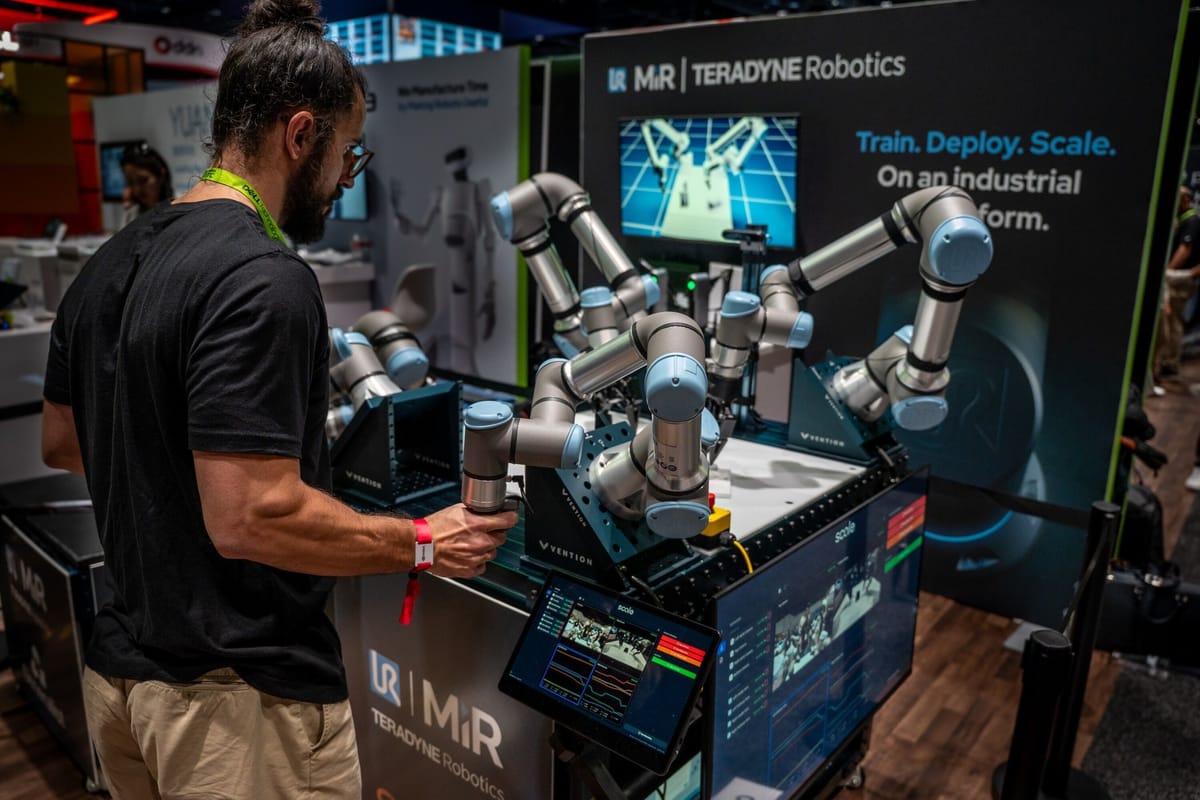
- Universal Robots and Scale AI introduced a system that captures synchronized robot, force, and vision data directly in production environments.
- A guided robot setup enables real-time data collection for training Vision-Language-Action models using the same machines deployed in industry.
Universal Robots introduced a system that captures synchronized data from robots in production environments, rather than in separate lab setups. Built with Scale AI, it is designed for customers ranging from enterprises to AI research labs that need to train models on the same robots they intend to deploy. The system reflects a shift from pre-programmed robotics toward systems trained through data.
"Our customers, ranging from large enterprises to AI research labs, are no longer just asking for AI features," said Anders Beck, VP of AI Robotics Products at Universal Robots, in a press release. "They need a way to collect high-fidelity, synchronized robot and vision data to train AI models on the same robots they intend to deploy. Our AI Trainer is the industry's first direct lab-to-factory solution for AI model training."
The system uses a leader-follower setup where human operators guide robots through tasks while data is captured in real time. It records motion, vision, and force data, using torque control and force feedback to capture how the robot physically interacts with objects, including contact-rich tasks. Scale AI provides the software layer that structures this data and supports continuous optimization.
Universal Robots reports it has deployed more than 100,000 collaborative robots worldwide. Scale AI develops and evaluates AI systems for enterprise and government use. The companies say the system enables customers to train, deploy, and improve models faster. As part of that effort, a large-scale dataset collected on Universal Robots systems is expected later this year.
🌀 Tom’s Take:
This closes a critical gap in robotics: training AI on the same systems used in production. By turning real-world operation into a continuous data engine, it shifts robotics from static programming to systems that improve through use.
Source: PR Newswire / Universal Robots