Tripo AI Secures $50M to Advance Native 3D Generation Models

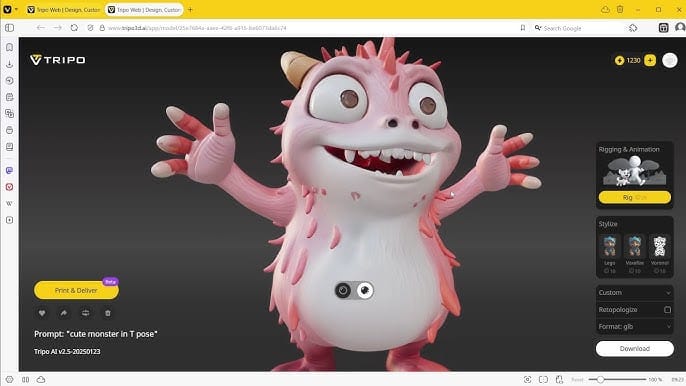
- Tripo AI raised $50 million from Alibaba and Baidu Ventures to support research and expand its developer platform.
- The company introduced new model families that generate 3D assets by modeling geometry directly in spatial space, allowing production-ready meshes to be created in seconds.
Tripo AI announced a $50 million funding round backed by Alibaba and Baidu Ventures. The company said the investment will support further development of its 3D generation models and expansion of its developer platform.
The company introduced new model families, including Tripo H3.1 and Tripo P1.0. Earlier systems often adapted methods from language or image models, turning 3D data into sequences before rebuilding shapes. Tripo’s models instead represent vertices, edges, and surfaces together in a shared spatial field, allowing the full structure to form at once rather than step by step. This approach improves consistency and enables production-ready meshes to be created in seconds. One model is designed for high-detail output used in industrial design, 3D printing, and cinematic production, while the other produces lightweight meshes built for game engines, robotics simulation, and XR applications.
"Much of today's generative AI is built around sequences," said Simon Song, Founder and CEO of Tripo AI, in a press release. "But three-dimensional space is inherently holistic and symmetric. When geometry is forced into a sequence, artificial structure is introduced. Our approach models shapes directly in native spatial space, allowing structure to emerge coherently."
Tripo AI said its platform has grown to more than 6.5 million creators and 90,000 developers, with nearly 100 million 3D assets created so far. It reported that assets can now be generated in seconds using parallel processing across the model. The company also pointed to ongoing work on a world model effort focused on systems that can simulate and interact with spatial environments.
🌀 Tom’s Take:
If 3D assets can be generated quickly and come out clean enough to use right away, teams don’t have to spend extra time fixing or rebuilding them before they go into a project.
Source: PR Newswire / Tripo AI