The 90s Tech That Let Me Step Into the Future as a Kid

For many, virtual reality feels like a recent technology, something they may have first heard of when Facebook (now Meta) acquired Oculus in 2016. But VR, along with other immersive technologies like augmented reality, has a much longer history. In fact, these technologies go as far back as the late '50s/early '60s, when Morton Heilig created the Sensorama (1956) and Ivan Sutherland built the Sword of Damocles (1968), both credited as the first VR and AR experiences, respectively.
Ironically, one of the things I do most when exploring emerging technologies is look back at the past. Understanding where we’ve come from is often a great way to identify pitfalls and the possibilities that lie ahead. It also gives a great perspective on just how far things have evolved in a relatively short time.
The recent re-release of Nintendo’s Virtual Boy for the Switch, initially launched in 1995, got me incredibly nostalgic. Growing up in the 90s, I remember when games started to reach beyond the screen. Holographic displays and motion gadgets offered a glimpse of how technology could change the way we play and connect with the world.
Here are a few '90s experiences that left a lasting impact on me, and made the digital world feel close enough to touch.
Nintendo Power Glove
I didn’t get a Virtual Boy when I was a kid, but I did get to play with the Nintendo Power Glove when I was about twelve, around 1990. This gaming accessory was the ultimate in cool, especially having made its debut in the Fred Savage film The Wizard, which is a story about two brothers on their way to a national Nintendo gaming championship. The Power Glove was probably the first time I used something that brought my body into a computer game. It let you control the action on the screen with your hands and turned your arm into the controller. Wearing it felt powerful, and it was the closest thing at that time to feeling like you were in the game, certainly much more intimate and personal than the typical controller.
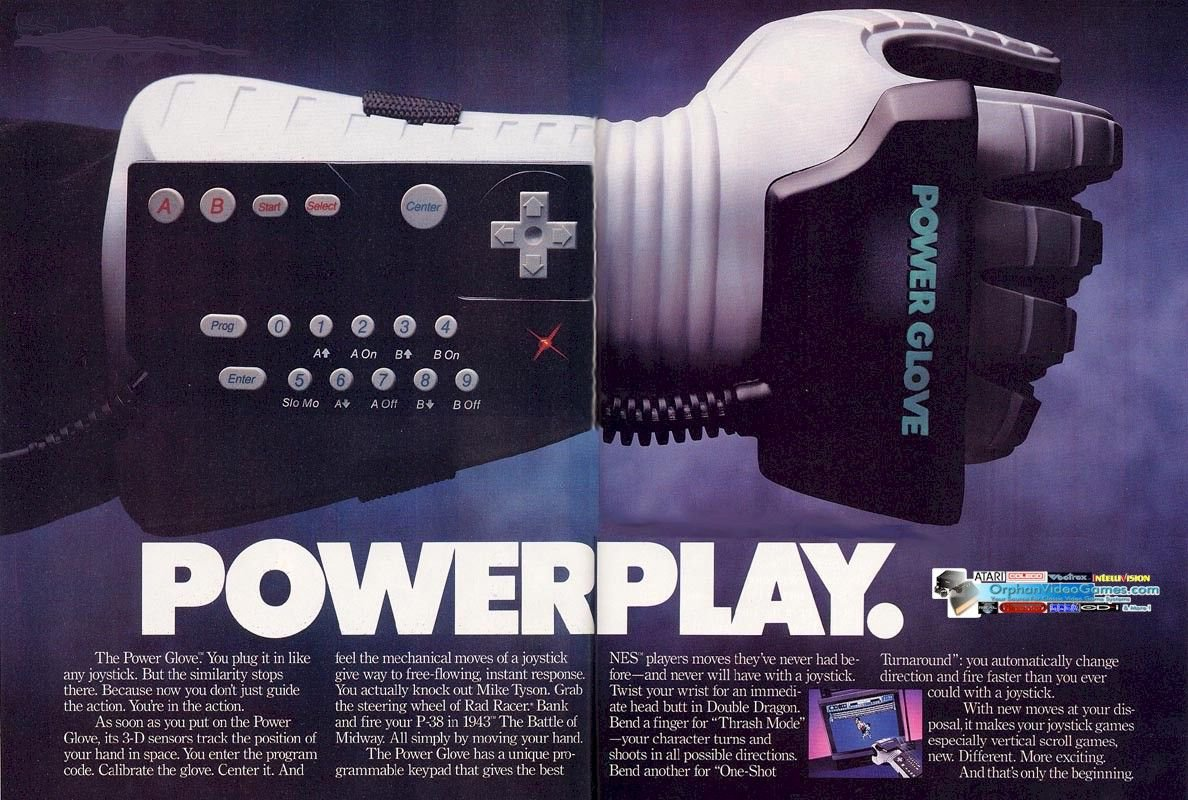
The Nintendo Power Glove, manufactured by Mattel in the USA, was released in 1989 and was among the first consumer devices to bring gesture-based motion control into home video gaming. The glove used resistive flex sensors in its fingers and an ultrasonic tracking system to map hand orientation and position to on-screen actions. However, its tracking and responsiveness were quite limited, and it was only supported by a couple of games like Super Glove Ball and Bad Street Brawler. Its limitations didn't matter much as a kid, as it was an extremely cool accessory that was sure to make you popular on your street if you had one. The idea of controlling a game with your hands felt completely new, and it was the first time I realized technology could pull you into the experience, not just put something in front of you.
Source: YouTube / Retro Up
A few years before the Power Glove, Nintendo had already started exploring ways to make play feel more physical with R.O.B., the Robotic Operating Buddy. Released in 1985, R.O.B. was a small plastic robot that detected flashes of light from the TV screen using its optical sensor. These flashes triggered R.O.B. to slowly move, rotate, and stack plastic discs as you played. Just like the Power Glove, it only worked with two games, Gyromite and Stack-Up. R.O.B. showed that video games could reach beyond the screen into the real world.
Source: YouTube / Rad Universe
Nintendo continued this exploration with the Power Pad, a floor mat controller introduced in 1988. Players used their feet to run, jump, and step on large pressure-sensitive buttons, bringing full-body movement into games like World Class Track Meet and Dance Aerobics. The Power Pad and Power Glove both reflected Nintendo’s early attempts to make gaming more physical and to bring your body into the gameplay.
Source: YouTube / Genkisan
Sega Time Traveler Holographic
When I was thirteen, I remember being on vacation in Florida, where I stumbled upon a tabletop arcade cabinet that felt like it had been sent back from the future. The machine looked futuristic with its sleek, white, spaceship-like design, and the game itself felt just as otherworldly. It was as if you were controlling tiny holographic people who lived inside the cabinet in a miniature world brought to life by light and mirrors instead of characters on a screen.
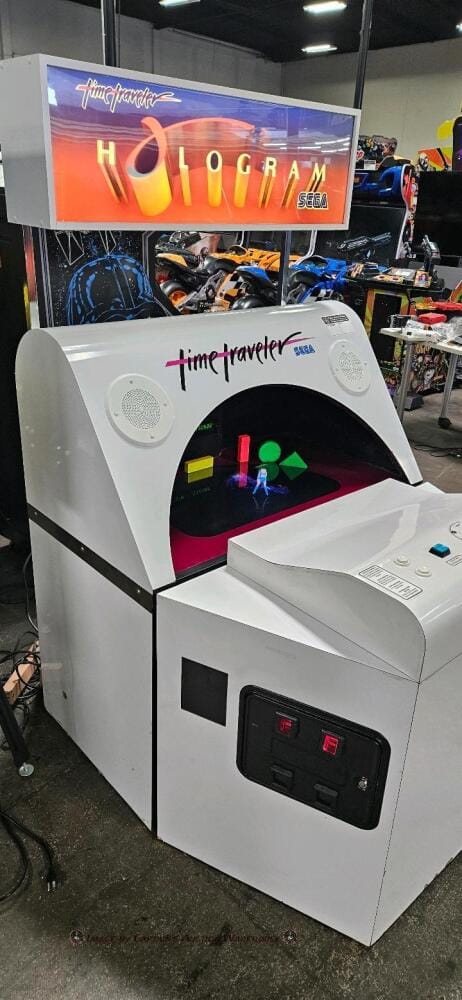
The game turned out to be Sega’s Time Traveler, which was released in 1991 and created by Rick Dyer, the same mind behind Dragon’s Lair. It was marketed as the world’s first “holographic” video game, which honestly felt right when you played it in person. Instead of a regular screen, the cabinet used a curved mirror and a version of Pepper’s Ghost, a trick from 19th-century stage magic, to project live-action footage of real actors. You played as a cowboy named Marshal Gram, jumping through time to take down villains from the Wild West to the far future. Looking back, that moment was probably my first real glimpse of what we now call augmented reality. It felt like those digital characters were standing right there beside you.
Source: YouTube / Mango Pictures
Sega kept experimenting with immersive gameplay throughout the 90s. In its arcades, the company introduced the VR-1 motion simulator in 1994, a full-body attraction that moved and reacted in sync with the gameplay. At home, it released the Activator for the Genesis in 1993, a plastic octagonal infrared ring laid on the floor to detect gestures like punches, kicks, and sweeps. One of the few games to fully support it was Eternal Champions, which let players throw punches and kicks in real life to control the on-screen fighters.
Source: SEGAnetwork
Virtuality 1000CS
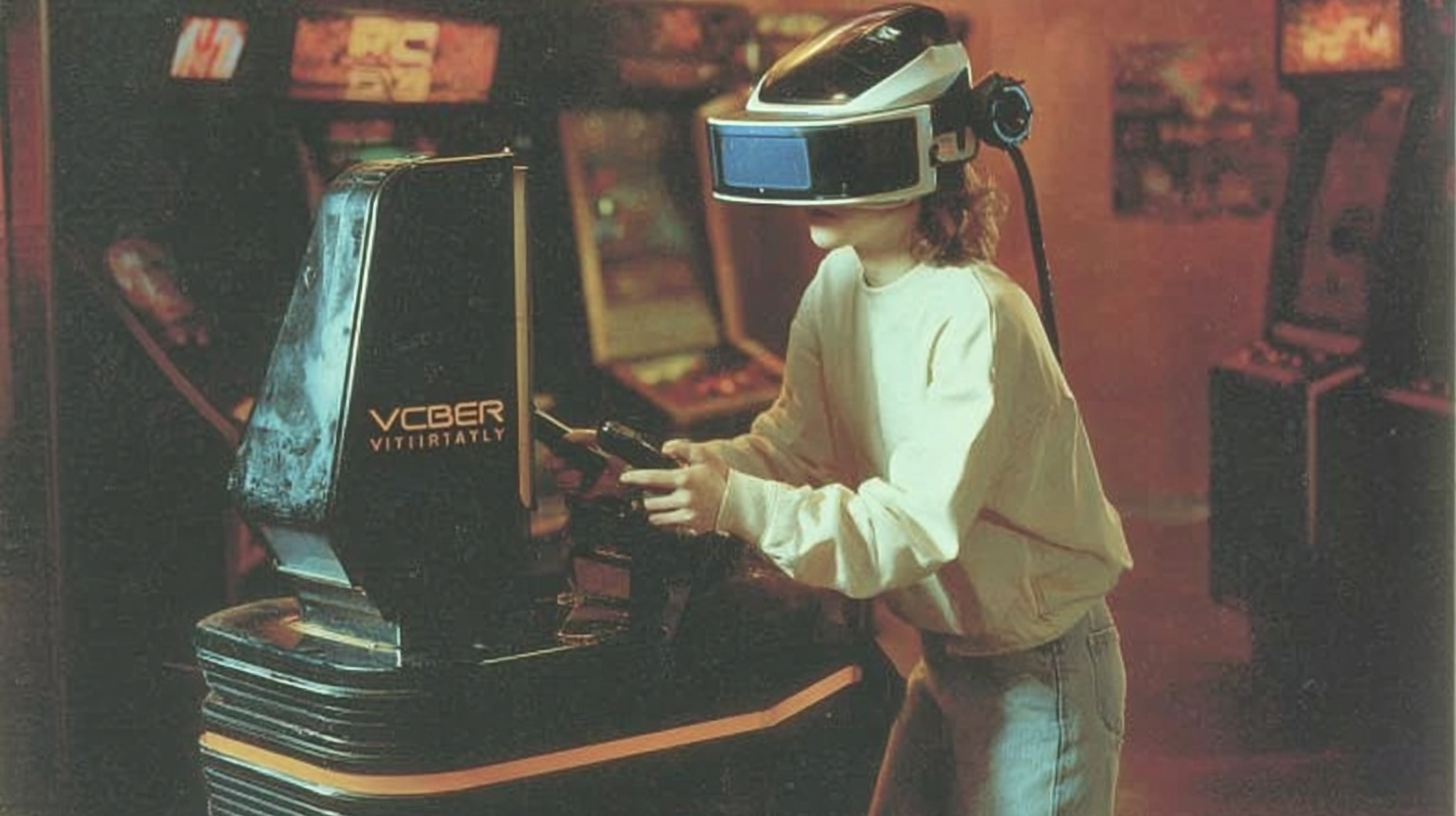
One of my earliest memories of virtual reality was being led into a circular pod at Canada’s Wonderland, a theme park just outside Toronto, Ontario, where I was strapped into a headset at least double the size of my head. I was around 16 at the time, so it must have been 1994.
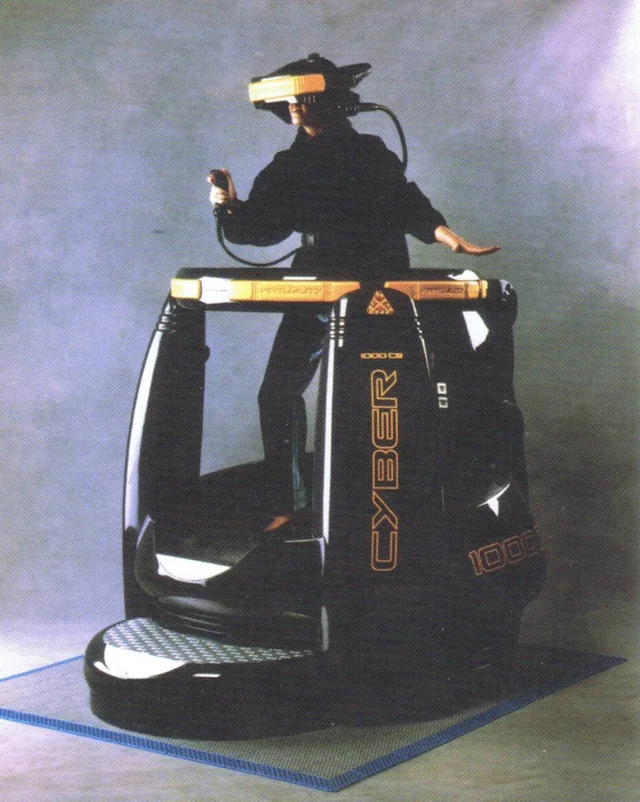
I think the game I played was Zone Hunter, a first-person virtual reality shooter where you used a joystick to fight enemies in a futuristic 3D city using the Virtuality system. The visuals of the game looked like they came straight out of The Lawnmower Man, a 1992 Sci-Fi movie about virtual reality. Glowing grids and geometric shapes made it feel like you were actually inside a '90s computer. In hindsight, it was rough and blocky, but at the time, it felt like stepping directly into the future.
Source: YouTube / Captain Nemo
Virtuality began under W Industries (later Virtuality Group), and by 1991, it was rolling out one of the first commercial VR systems. Arcade venues, theme parks, and science centers hosted their bright color pods. These came in both sit-down and stand-up versions, each equipped with huge, bulky headsets, head tracking, and joysticks. In some setups, multiple players could connect and interact in shared 3D environments.
The system arrived in Canada around 1993, appearing at places like the Canadian National Exhibition and Canada’s Wonderland, where it quickly became a crowd favorite. Games such as Zone Hunter and Dactyl Nightmare, a networked 3D arena battle with flying creatures, drew long lines of players excited to try virtual reality for the first time. By 1997, Virtuality had gone bankrupt as interest in arcade VR faded and the technology fell behind. The machines were expensive, temperamental, and limited by the hardware of the era.
The 90s had plenty of rough edges and failed experiments, but they planted the seeds for what we’re seeing now. Mixed reality and embodied interaction are no longer toys we see in an arcade, but are shaping how we live, work, and play as the tools of tomorrow. Those early experiences inspired me, and probably so many others, to imagine what might be possible next.