Precision Agriculture Promises More Sustainable Farms, If the Tech Can Deliver

Visual AI and robotics technology are facilitating a fourth agricultural revolution. Precision agriculture, the use of spatial and temporal data to manage crops and resources more efficiently, promises to reduce human labor and more accurately target applications of pesticides and fertilizers. This creates the potential for more sustainable and less expensive cultivation practices.
Enabled by sophisticated imagery capture and machine learning and executed through a variety of automated mechanical devices, precision agriculture would seem to be the perfect example of AI as a net benefit to humanity. Indeed, a range of existing and experimental applications has shown great success. The technology, however, is still in its early days, and a range of practical and ethical problems remain to be sorted.
Up in the air
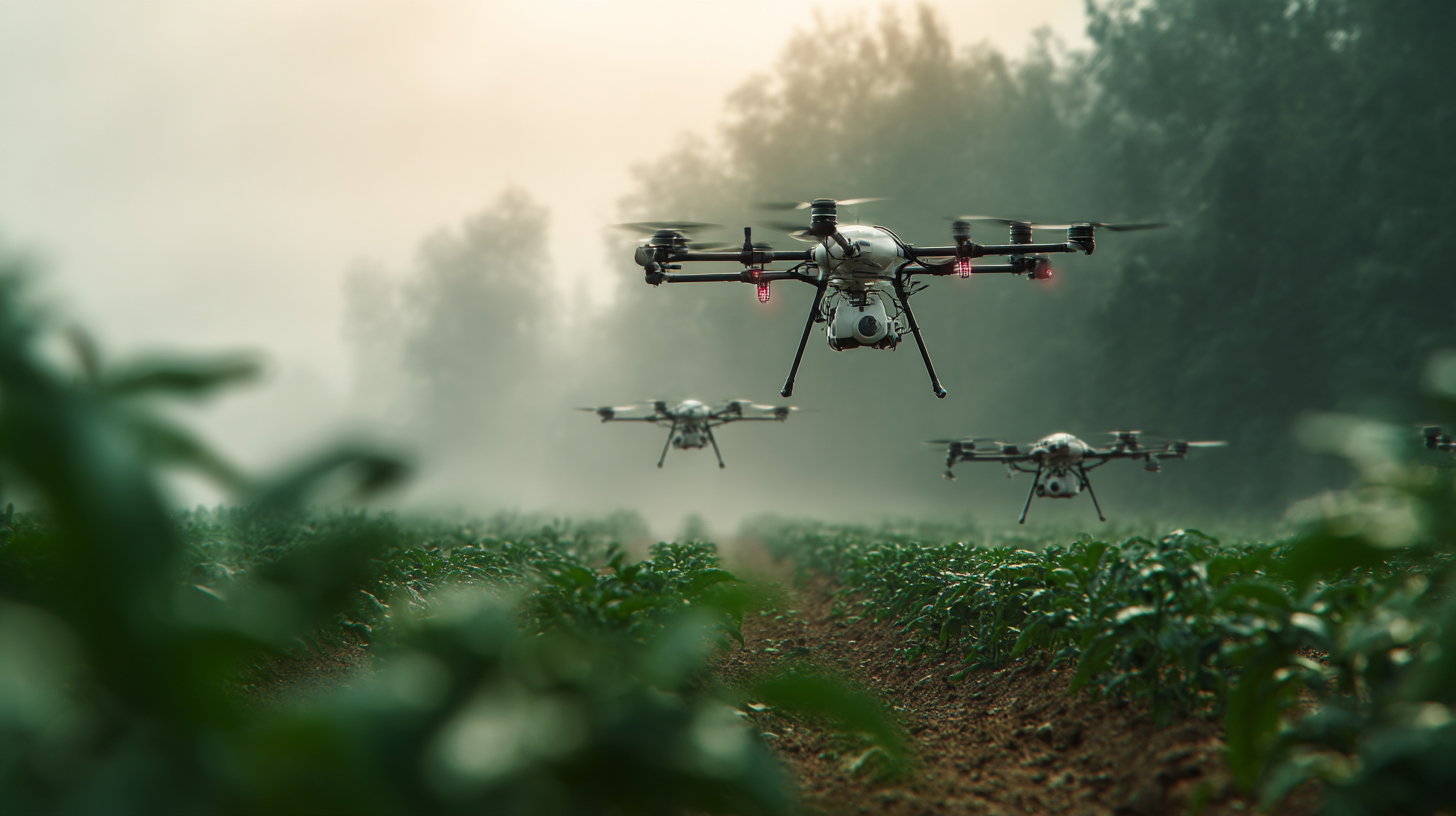
Using drones to capture images of crops from above has been invaluable to ML models that can analyze everything from drought stress and pest presence to harvest readiness. The discernment of patterns that would be difficult or impossible to detect from the ground creates potential for a wide range of efficiencies, through both traditional and technological means.
“Drones that are equipped with RGB or multi-spectral cameras can detect disease symptoms or malnutrition much earlier than a human,” says Zhaodan Kong, an associate professor at the University of California, Davis, who works with the university’s AI Institute for Next Generation Food Systems (AIFS).
Once an issue has been identified, it can be corrected in a precise manner. Water can be directed to an area of the field that is experiencing drought stress. Stressed plants can be identified with up to 97% accuracy using AI, according to one study. Another study found similar accuracy in pest identification, allowing for targeted application of pesticides to segments showing early signs of infestation. Fertilizer can be targeted to areas where it is needed and tapered off in areas where it is not. According to research, algorithmic detection of specific nutrient deficiencies can now achieve nearly 100% accuracy.
Drone images can be processed by ML algorithms to determine the exact time that crops are ready for harvest as well. Kong, for example, has worked on drone inspection of apple orchard yields. His research has resulted in technology that allows for more autonomous UAV flights, decreasing the need for human control as they navigate the orchards and scan for harvest data.
Drone images can also be used to monitor the efficacy of on-the-ground robotics applications such as weed removal. Some of these technologies are already on the market. Carbon Robotics, for example, sells a robotic weeder that uses computer vision, machine learning, and robotic implementation to zap weeds using a laser.
“It's really hard and expensive to get people in there to count weeds and count plants,” says Aaron Smith, a professor at the University of California, Berkeley, and also a researcher with AIFS, who is working on refining AI-assisted robotic weeding. “We fly drones remotely over fields to take up a bunch of images, both before and after a leader runs through to assess how well things are working.”
On the spot
“Precision agriculture is one of the most promising directions of applying AI and robotics in agriculture. It's basically precise identification and precise activation of the space for treatment,” Kong says. These applications can use images captured by drones or on-the-ground cameras to identify issues.
“Nitrogen fertilizer has massive benefits, as long as it goes into the plant and helps the plant grow,” Smith says. “When it does not do that and it sits in the soil, then it becomes a pollutant. It's either emitted as nitrous oxide, which is a greenhouse gas, or it's causing pollution in waterways.”
An algorithmic determination of areas that may need more or less fertilizer due to varying soil conditions in a particular agricultural plot reduces the potential for runoff. It also saves the farmer money on unnecessary applications, which may also be detrimental to the plants themselves.
“There are other technologies that will use computer imaging to target a weed so they can shoot a pesticide directly at it,” he says. “Some of those technologies might have a blast radius of five millimeters. Others have a much wider radius, much less precise, but still a lot less spray than if you applied it to the entire field.”
Reductions in chemical use are an undeniable environmental and probable human health benefit. While the environmental costs of AI energy use are significant, the models used in agricultural applications are far smaller than, for example, those used to train platforms such as ChatGPT. Smith thinks that the energy costs of training these models are negligible in comparison to their ultimate benefits.
AI and robotic applications may save on labor costs, too. “Labor is increasingly unavailable and expensive, and so that creates the need for new technologies,” he adds. Specialty crops are particularly labor-intensive, and managing them makes up the majority of the skilled agricultural workforce. Technological advancements may help to make up for shortages by augmenting the capabilities of workers who lack those skills.
In the wild
Though these visual systems and robotic applications offer the potential for major advances in agricultural practices, they are not without their challenges. Like many new technologies tested under lab conditions, they are unlikely to operate as intended on a larger scale at all times. While modern agriculture is arranged for predictability and homogeneity, environmental conditions are inherently volatile.
“Everything works in the lab or in the greenhouse,” Kong says. “In the field, you stumble because of changes in lighting conditions, soil conditions, and weather. We are trying to develop algorithms that not only work in the lab, but are also generalized and applicable in the field as well.”
Sometimes, the tech falters. And sometimes it fails entirely.
“I interviewed some Texas farmers who'd purchased an upgraded AI system that would scan for and take care of pests independently,” said Bennett Barrier, CEO of DFW Turf Solutions. “When they brought it into practice, it could not differentiate between hazardous pests and other helpful insects. It created unforeseen losses.”
The algorithms that run the programs may be over-generalized and lead to damaging recommendations, applications of substances where they may not be appropriate, or destruction of organisms that are actually beneficial.
Even in cases where the tech itself is generally functional, the ease of use may become an issue. Integrating it into even the most modern agricultural operation can be challenging. If maintenance and deployment add time and labor, it becomes an irritating, even intimidating hurdle for farmers to clear.
“There is a disconnect between what we researchers develop and what the farmers need,” Kong acknowledges. “We have to engage with the farmers from the start.”
He cites the example of an apple-picking robot devised by a startup. “They focused on the hard part, how to precisely position your grab and pick the apple. But they forgot that you have to put the apple somewhere and store it,” he laughs.
Because these systems are reliant on digital connectivity, issues such as internet access can be problematic. “Figuring out ways for these machines to be able to operate in an environment where they don't have high-speed internet every single second as they're going through a field is a technical challenge,” Smith notes.
Workforce difficulties
While AI-enabled tech offers the potential for savings on labor costs and the ability to make up for shortfalls in labor availability, it also presents problems both for those who use it and those who don’t.
“The technology is moving so quickly that if you invest in a laser weeder that's a million-dollar machine, you worry about it becoming obsolete as technology improves,” Smith says.
At the same time, smaller farmers may have less access to costly new technology or be less willing to spend on it in a rapidly evolving landscape.
Fee-for-service platforms will help to make up some of the difference. Both larger operations and small holders can avoid the hassle and expense of purchasing the technology outright by contracting with providers to bring the equipment and expertise to them. This may be an ideal interim solution as the technology is scaled.
Data use and ownership
Agricultural AI is not just about harvesting crops. Data is even more valuable than the products picked from a field in a given season. Who owns this data and how it is commodified remains a salient question for farmers experimenting with the technology.
How that data is used and shared is crucial to the ethical deployment of AI in agriculture.
“A lot of companies sell closed systems to the farmers. The farmers cannot see and sometimes do not even own the data,” Kong notes. Data sovereignty will likely become a serious issue as these technologies are deployed. The data harvested and fed into the programs that power these systems is valuable, and it is unclear whether farmers are being fairly compensated in all cases.
“Maybe the farmers can get some incentive for sharing the data,” he suggests. “Companies do need the data to improve their models.”
Data privacy is also crucial. As Smith observes, if data is not secured, it could open farmers up to scrutiny from suppliers and government regulators.
“Something on those images may show that you have a pathogen that leads to a foodborne illness outbreak,” he says. “Growers increasingly worry about how this data could be used against them in some way.”
AI in agriculture is expected to become a nearly $11 billion market in the next decade, according to Research and Markets. As these visual and robotic systems are deployed more widely, it will be incumbent on both watchdogs and farmers themselves to monitor the balance. As the digital plow speeds ahead, attention must be paid to its potential casualties.