NVIDIA Expands Its Robotics Stack as Industry Builds on Its Platform

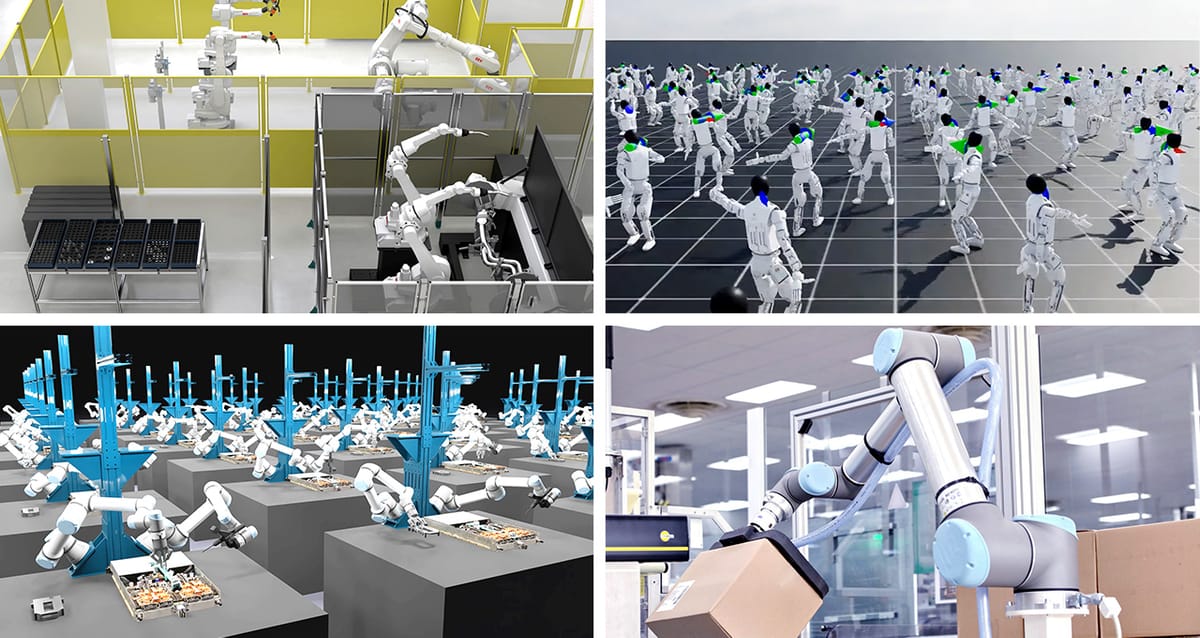
- NVIDIA introduced Cosmos 3, Isaac Lab 3.0, and GR00T models at GTC 2026 to support training, simulation, and deployment of robotics systems.
- Robotics and healthcare companies including ABB Robotics, Skild AI, and CMR Surgical are using NVIDIA’s platform to build and deploy physical AI systems.
At GTC 2026, NVIDIA introduced a set of updates across its robotics technologies, focused on how robots are trained and developed. Cosmos 3 is a world foundation model that brings together synthetic world generation, vision reasoning, and action simulation, used for synthetic data generation and simulation of robot perception and action in complex environments. Isaac Lab 3.0 enables large-scale robot learning with multiphysics simulation and expanded support for dexterous manipulation, built on the Newton physics engine and PhysX software development kit.
NVIDIA also expanded its GR00T robot models, bringing generalized robot skills to robotic systems. GR00T N1.7 is now available in early access with commercial licensing, including advanced dexterous control for production-ready deployments. The company also previewed GR00T N2, a next-generation model based on a new world action model architecture that helps robots succeed at new tasks in new environments more than twice as often as leading models. These models run on Jetson Thor, which enables developers to move from simulation training to real-world deployment.
“Physical AI has arrived — every industrial company will become a robotics company,” said Jensen Huang, founder and CEO of NVIDIA, in a news release. “NVIDIA’s full-stack platform — spanning computing, open models and software frameworks — is the foundation for the robotics industry, uniting a worldwide ecosystem to build the intelligent machines that will power the next generation of factories, logistics, transportation and infrastructure.”
NVIDIA is working with a broad group of robotics companies spanning industrial systems, humanoids, and surgical platforms, including ABB Robotics, FANUC, KUKA, Figure, Medtronic, and Universal Robots. These companies are building on NVIDIA’s computing, models, and software to develop and deploy physical AI at scale. The ecosystem also includes robot brain developers and cloud providers building on NVIDIA’s platform for designing, training, and deploying robotics systems.
Skild AI is partnering with ABB Robotics and Universal Robots to deploy its generalized robot intelligence across their systems, as part of the broader ecosystem building on NVIDIA’s platform. In healthcare, CMR Surgical uses Cosmos-H simulation to train and validate the Versius system, while Johnson & Johnson MedTech uses Isaac Sim and Cosmos workflows for the Monarch Platform for Urology.
NVIDIA has also partnered with Hugging Face to integrate Isaac and GR00T into the LeRobot open source framework, connecting NVIDIA’s 2 million robotics developers with Hugging Face’s 13 million AI builders to support open source robotics development.
🌀 Tom’s Take:
NVIDIA is positioning itself as the infrastructure layer for robotics, supplying the compute, simulation, and models that others build on rather than competing at the application level.
Source: NVIDIA