Meet the MR Marketing Pioneers

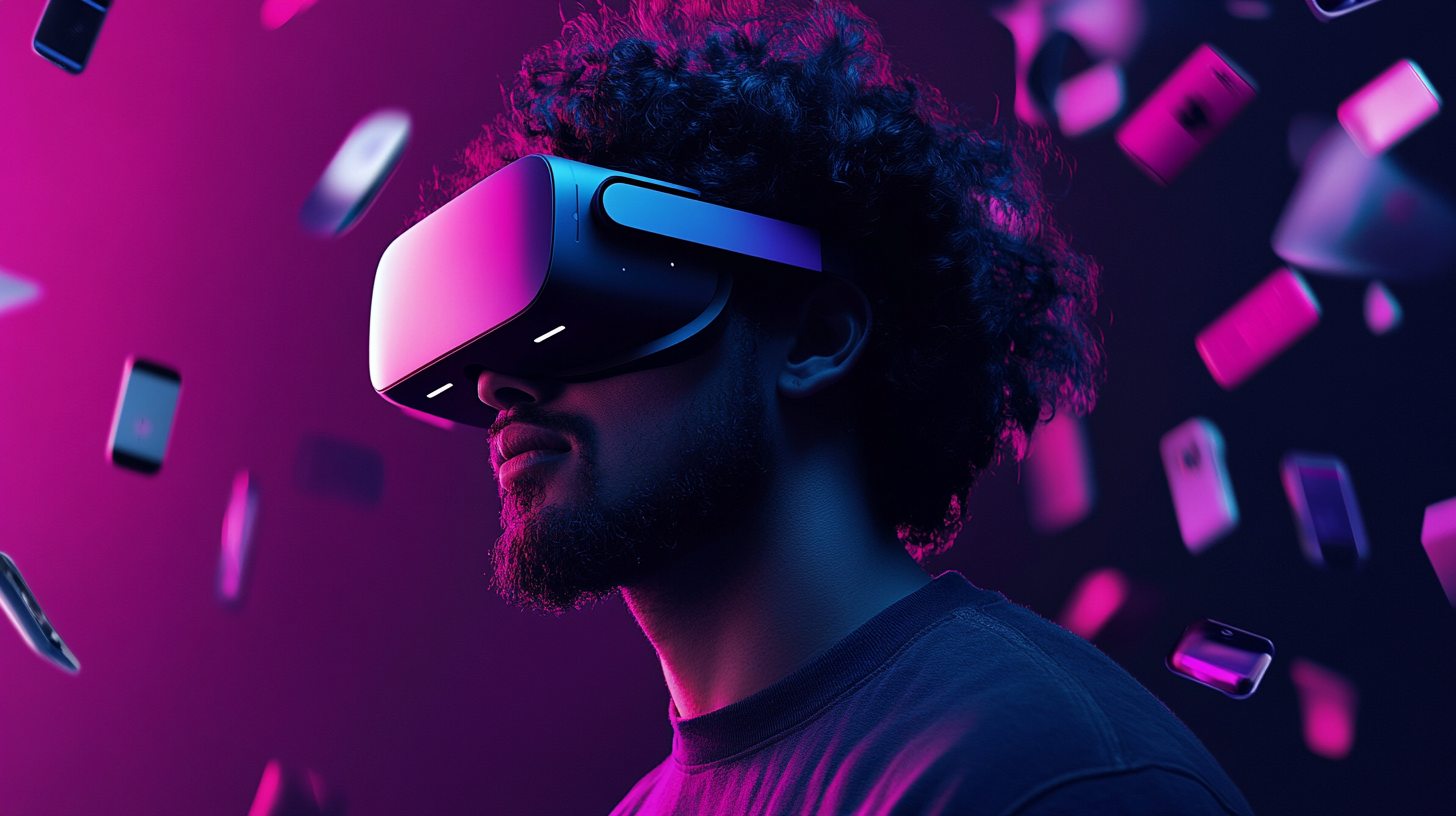
- NBCUniversal illustrates how to open a portal to IP to give fans an experience that is out of this world.
- Gucci gives a masterclass on making 2D content work in spatial computing.
- Hyundai Card showcases how mixed reality can take experiential marketing to new heights.
- This excerpt comes from a chapter of The Next Dimension by Tom Emrich.
Companies have already begun tapping into the immersive power of MR headsets, propelling their brands into the next dimension. These innovators are not only leading the charge on what is possible for marketing in mixed reality but are also benefiting from valuable early learnings from having in-market content engaged by users.
Snickers Brings Football and Fortunes into Your Living Room
One of the first marketing experiences launched for Apple Vision Pro was for Snickers as part of its “Rookie Mistake” campaign. In partnership with technology company Blippar and The Mars Agency, the Snickers brand launched an MR app for the Apple Vision Pro just in time for the Super Bowl LVIII.
The experience gives headset wearers the ability to simulate kicking a field goal in their living room through a goalpost made of Snickers bars. After scoring, they interact with a virtual version of Pittsburgh Steelers’ T. J. Watt, who is inside a fortune teller box acting as a “misfortune teller.” Watt encourages users to share an embarrassing rookie mistake. After they tell their story, the fortune-telling box reveals a life-size Snickers vending machine where users enter a sweepstakes to win prizes directly in the app or click a link to be taken to the Snickers website to buy some candy bars.
A similar experience is also available on the smartphone.
This spatial computing experience by The Mars Agency was well timed. The campaign took advantage of being first to market, riding the wave of Apple Vision Pro news as the device just came out the week before the app launch. It also helped the campaign break through a noisy and competitive time for marketing, the Super Bowl.
Leveraging innovative technology gave journalists and users something new. As the AR experience could be engaged both inside the headset and on a smartphone, it is an excellent example of cross-device thinking with your creativity. This helps your campaign pack a punch on the immersive headworn wearable as the campaign hero while enabling your content to engage with as many people as possible via the smartphone.
NBCUniversal Opens a Portal to a Panda and Peace
NBCUniversal launched an Apple Vision Pro app, Kung Fu Panda: School of Chi, to promote its latest film, Kung Fu Panda 4. Developed by Nexus Studios, this DreamWorks Animation app opens a portal to The Valley of Peace, the world featured in the movie.
Inside the portal, the lead animated character, Po, guides users through meditation as part of a kung fu practice. Users follow Po’s lead, copying his moves and learning meditative patterns by moving their hands and body while wearing the headset. Users are rewarded when they complete a series of movements by a fully grown cherry blossom tree, which spreads its branches far beyond the portal into the user’s physical space.
Along with the interactive experience, the app allows users to watch a 3D version of the Kung Fu Panda 4 trailer on a screen set in an immersive environment of The Valley of Peace, where they can also purchase movie tickets on Fandango.
NBCUniversal’s app on Apple Vision Pro is a great fit, especially as Kung Fu Panda 3 is also available as a 3D movie to watch on the device. It also leans into one of the primary use cases Apple is highlighting for the Apple Vision Pro: media consumption, which is sure to resonate with headset owners.
NBCUniversal could have just launched the 3D movie trailer for its latest movie, but instead, it took this opportunity to debut an interactive portal experience to leverage more of the device’s capabilities. This was a wise choice because it offered a brand-new look into a franchise that has existed since 2008.
For the first time, Kung Fu Panda fans can get up close with the film’s lead character and share an experience together that could only be made possible in an MR headset. The app’s body tracking gives Po a greater sense of presence as it feels as if he is watching and ensuring you are following his movements. Sometimes, he shakes his head when you aren’t mimicking his hand gestures correctly.
The moments in which Po’s world starts to creep out from beyond the portal into the real physical world of the user intensify this new connection with the film. This is all designed to sell you tickets to the next movie in this series and make you an even bigger fan.
Diageo Serves Up Cocktails and Culture in Headset
Diageo became the first beverage company to launch a marketing experience for Apple Vision Pro. The premium beverage leader chose to showcase its luxury brand, Tequila Don Julio, in an immersive storytelling experience exclusive to Apple’s new spatial computer.
The app offers tequila fans an up-close view of the brand’s heritage, the stories of its creators, and the intricate production process of the product – agave harvesting, piñas baking, distillation, and aging.
The app, which Diageo’s Innovation Team created in collaboration with leading XR agency Trigger XR, uses a mix of immersive video and 3D content in the user’s space to help users explore the phases of tequila production and also features guided tastings, mixology tutorials, and celebrations of Mexico’s contemporary cocktail culture. It also used the device’s hand tracking to do things such as harvest pencas (the large, fleshy leaves) from a fully matured agave.
“Apple Vision Pro offers us a new opportunity to bring consumers closer to the vibrant world of modern Mexico and all that goes into making Tequila Don Julio an iconic brand,” said Sophie Kelly, senior vice president of Global Tequila and Mezcal Categories at Diageo, in a press release. “Spatial computing gives us a rich canvas to deliver the closest version of the physical world of Tequila Don Julio through digital content while allowing users to stay wherever they are in the world. What was once limited to visitor centers, distillery tours, and physical activations, we’re now able to inspire and educate seamlessly with behind-the-scenes access to our award-winning portfolio.”
Diageo’s MR experience used the Apple Vision Pro’s high-resolution display and infinite canvas to show its content on a theater-sized screen and the ability to change the lighting in the user’s space to create an intimate experience with the luxury brand. The mix of video and 3D content, including interactive moments, fully utilized the magic of MR.
Along with a compelling user experience, Diageo also used the launch of this first-of-its-kind for spatial computing to highlight its commitment to innovation by raising the in-house Innovation Team it has established to future-proof Diageo brands by gaining key learnings on new platforms that will eventually become staples in the marketing mix.
Gucci Reimagines the Fashion Documentary in 3D
Luxury fashion brand Gucci also joined the early brands to launch an app for the Apple Vision Pro. Launched at the beginning of April 2024, the Gucci app engages users in an immersive adaptation of the documentary Who Is Sabato De Sarno?, which follows creative director Sabato de Sarno preparing his debut collection in the Gucci Ancora show.
The Gucci app for Apple Vision Pro offers a new and exciting way to engage users with video content. The app combines 2D video with immersive environments, 3D elements, and interactive moments introduced throughout the screening. This heightens the experience for the viewer in ways only possible in a headset.
Viewers begin by watching the documentary on a theater-sized screen floating in their space. During certain moments of the film, 3D elements appear in the viewer’s space, such as a massive 3D model of an airplane appearing above the screen during a travel sequence. A train track appears, and a large red train arrives in the viewer’s space, timed perfectly with its entrance in the film.
When the documentary introduces the original location for de Sarno’s debut show in the city of Milan, the viewer’s physical, real-world environment fades, and they find themselves watching the documentary in the alley depicted in the film, complete with de Sarno’s dog walking down the street.
Finally, at various times throughout the documentary, the viewer can interact with 3D models of objects in the film they are currently viewing. Most of these points invite viewers to explore high-quality 3D models of Gucci apparel and accessories, such as the Gucci Horsebit platform loafer and Gucci Bamboo 1947 handbag.
The Gucci Apple Vision Pro experience is a masterclass in combining legacy 2D media with new spatial content – the new multimedia. This new-meets-old approach can only be achieved with a spatial computer. The documentary has a style, pace, and soundtrack that only improves when moments of immersion are added.
Gucci has also taken a thoughtful approach to the interactive moments, ensuring viewers can choose when and how to engage with them. The interactive moments give viewers the option to get up close with 3D models relevant to their location in the film.
The 3D models of Gucci accessories featured in the experience, such as the iconic Gucci Loafers or Jackie handbag, were extremely high quality, which was even more evident with Apple Vision Pro’s high-resolution screen and when you manipulate the models, such as rotate or pinch and zoom, to get up even closer.
Overall, the documentary experience took a very intelligent approach to immersion. When 3D elements were introduced, they were additive and enhanced the overall experience. In a sea of e-commerce brand experiences at the launch of Apple Vision Pro, Gucci made the conscious decision to go in a different direction.
According to a social post on LinkedIn from Micael Barilaro, Gucci VP of Brand Innovation Ventures:
“While recent applications of the Apple Vision Pro have predominantly revolved around e-commerce, we recognized the importance of charting a distinct course that resonated with our brand ethos. Our focus lies in crafting curated, emotionally resonant experiences that place emphasis on meaningful engagement.”
Hyundai Card’s Dual-Reality Event
Whereas the MR experiences highlighted so far are aimed at users at home, Hyundai Card, a credit card company under Hyundai Motor Group, made an MR experience that could only be experienced by users at an event activation.
DaVinci Motel in Mixed Reality was a cultural festival hosted by Hyundai Card in 2023 in collaboration with Meta. According to a case study on the Quantum Universe website, the agency that created the experience, the MR-activated event was inspired by Leonardo da Vinci and ’70s motels in California.
The experience blended the real-world physical location of the Hyundai Card Music Library in Seoul with virtual content, transforming the building into a vintage DaVinci Motel.
Event attendees virtually checked into the DaVinci Motel using the Meta Quest Pro. Attendees were presented with a virtual key to the DaVinci Motel and then were walked through the check-in process before engaging with the virtual characters staying at the motel. Attendees could also interact within the virtual world of the DaVinci Motel by leaving their signatures on LPs, refueling a virtual classic car, and more as part of the phygital experience.
Hyundai’s DaVinci Motel campaign was a compelling brand activation that illustrates how to use mixed reality in your event marketing. As not everyone has an MR headset at home, creating an event experience that provides attendees with a headset ensures your content will be used. An MR-powered event activation can be a crowd-pleaser for attendees purely for the chance to try out devices they currently don’t have at home.
Hyundai Card’s use of MR also demonstrates how MR-activated events give marketers more control over the user’s environment, which gives the brand much more creative control over the experience. It enables MR content to be closely tied to a specific location, such as a building at the event, a booth, or a creative set constructed for the experiential marketing activation.
Excerpted from "The Next Dimension: How to Use Augmented Reality for Business Growth in the Era of Spatial Computing" by Tom Emrich (2024). © Tom Emrich. All rights reserved. Published on Remix Reality with permission.