How China Is Building a $489 Billion Economy in the Sky

- China’s low-altitude economy is forecast to reach CNY 3.5 trillion (USD 489 billion) by 2035, per the Civil Aviation Administration of China.
- Around 77,000 companies drive China’s low-altitude economy, from drones to light aircraft for commerce, according to the Academy of Chinese Studies.
Imagine arriving at a meeting on the 63rd floor of an office tower in Shenzhen. "What a view," you say, looking at the cluster of buildings that have cropped up seemingly within a stone's throw of Hong Kong.
"What a waste, you mean!" your business partner exclaims, pointing out the window. "The next economic boom won't be in buildings. It will be up there," he says, gesturing to the sky. "We should be maximizing that space for economic activity."
Chinese authorities have expressed their aspiration to transform the airspace below 3,000 meters into commercial space. The plan was officially presented in the Report on the Work of the Government at the National People's Congress in January 2024 by Premier Li Qiang. The objective is to accelerate the supervision system for skyway infrastructure and encourage what it calls low-altitude industries, in tourism, air sports, and consumer drones.
To realize this vision, China has ambitious plans to develop 6G infrastructure, an essential element for the low-altitude economy to take off. This requires an Integrated Sensing and Communication (ISAC) network capable of sensing and monitoring the spatial location of passive (non-connected) objects while communicating with mobile networks, according to China’s Ministry of Industry and Information Technology.
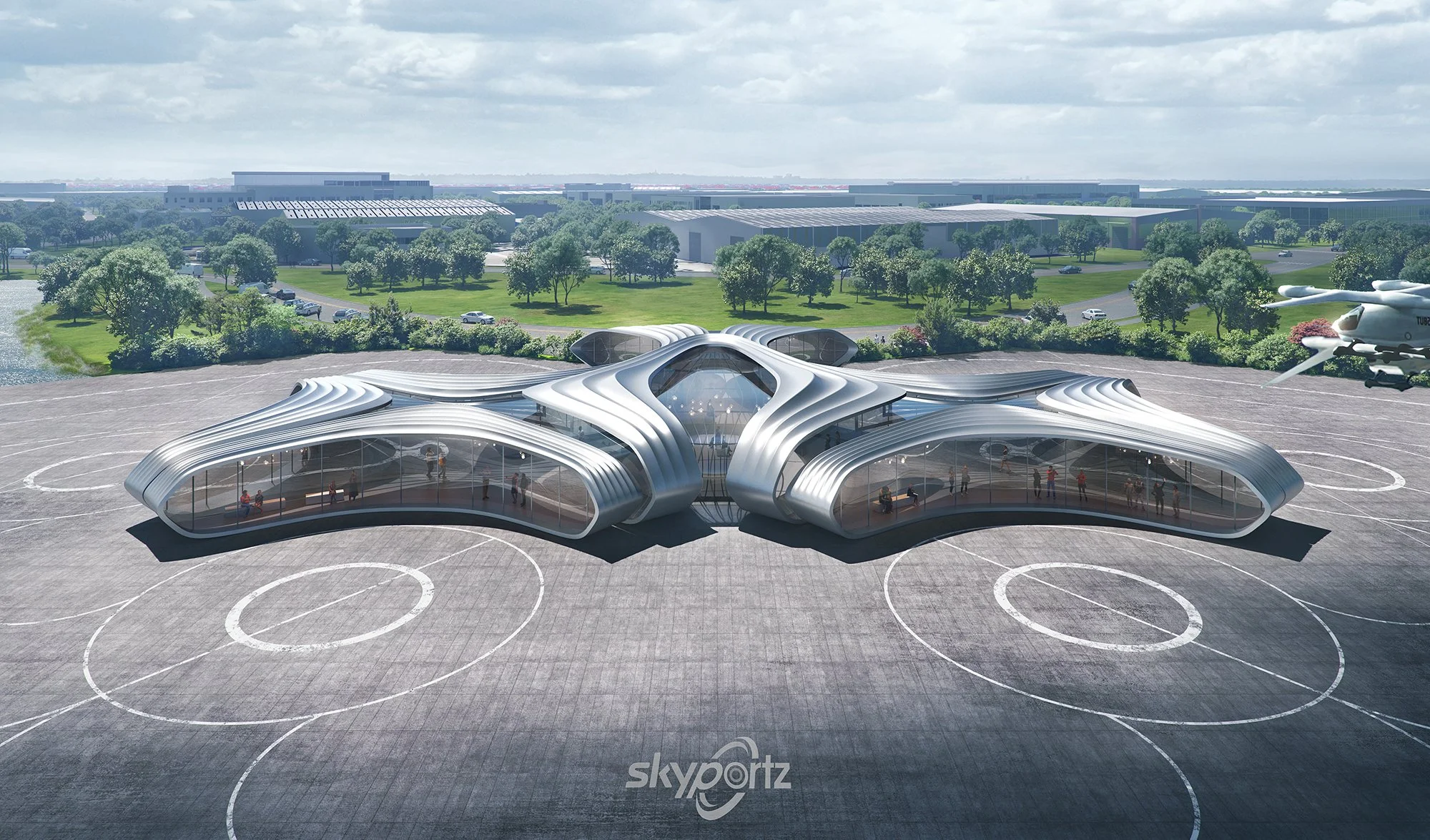
The plan envisions cities across China installing takeoff and landing points for electric vertical takeoff and landing (eVTOL) aircraft for large-scale commercial use. These vertiports would serve as local hubs connecting cities not covered by traditional aircraft and slowed by ground transportation.
Today, the primary challenge to increasing the number of air taxis is where they will land.
The challenge with creating a network of vertiports (parking spaces for air taxis) is the intense downwash and outwash from rotor blades. Downwash is the downward deflection of air caused by rotors generating lift, while outwash is the horizontal spreading of this air when it hits the ground. This not only scatters debris, but can be dangerous in contained spaces, which is why vertiports generally require large clearance zones around landing pads.
Skyportz, an Australian company delivering the “infrastructure of the future,” has developed a patented vertipad design that breaks up the airflow and dissipates wind energy up to 250% faster than a flat landing surface. The company announced in a press release that it had recently partnered with Shenzhen-based Haylion Technologies to introduce a network of over 1,000 vertiports, supporting Shenzhen’s ambitious urban air mobility plans.
A McKinsey study shows that the closer passengers are to a vertiport, the greater their potential time savings and the more likely they are to consider taking one. Morgan Stanley Research projects that the global urban air-mobility market could reach approximately $1.5 trillion by 2040, encompassing passenger transport, cargo delivery, and related services
There are now over 77,000 low-altitude economy-related enterprises in China, according to a report by the Academy of Chinese Studies. Drones are among the most common aircraft. Various local governments, including Shanghai and Beijing, are incentivizing businesses to develop the low-altitude economy. But it's Shenzhen, the city with a longstanding reputation for innovation and the de facto "drone capital" of the world, that has made the greatest strides in low-altitude infrastructure. The presence of leading drone makers such as DJI helps. The city is home to 45 drone and eVTOL manufacturers and more than 11,000 low-altitude economy enterprises, with nearly 9,000 located in Shenzhen and Guangzhou alone, according to the same report.
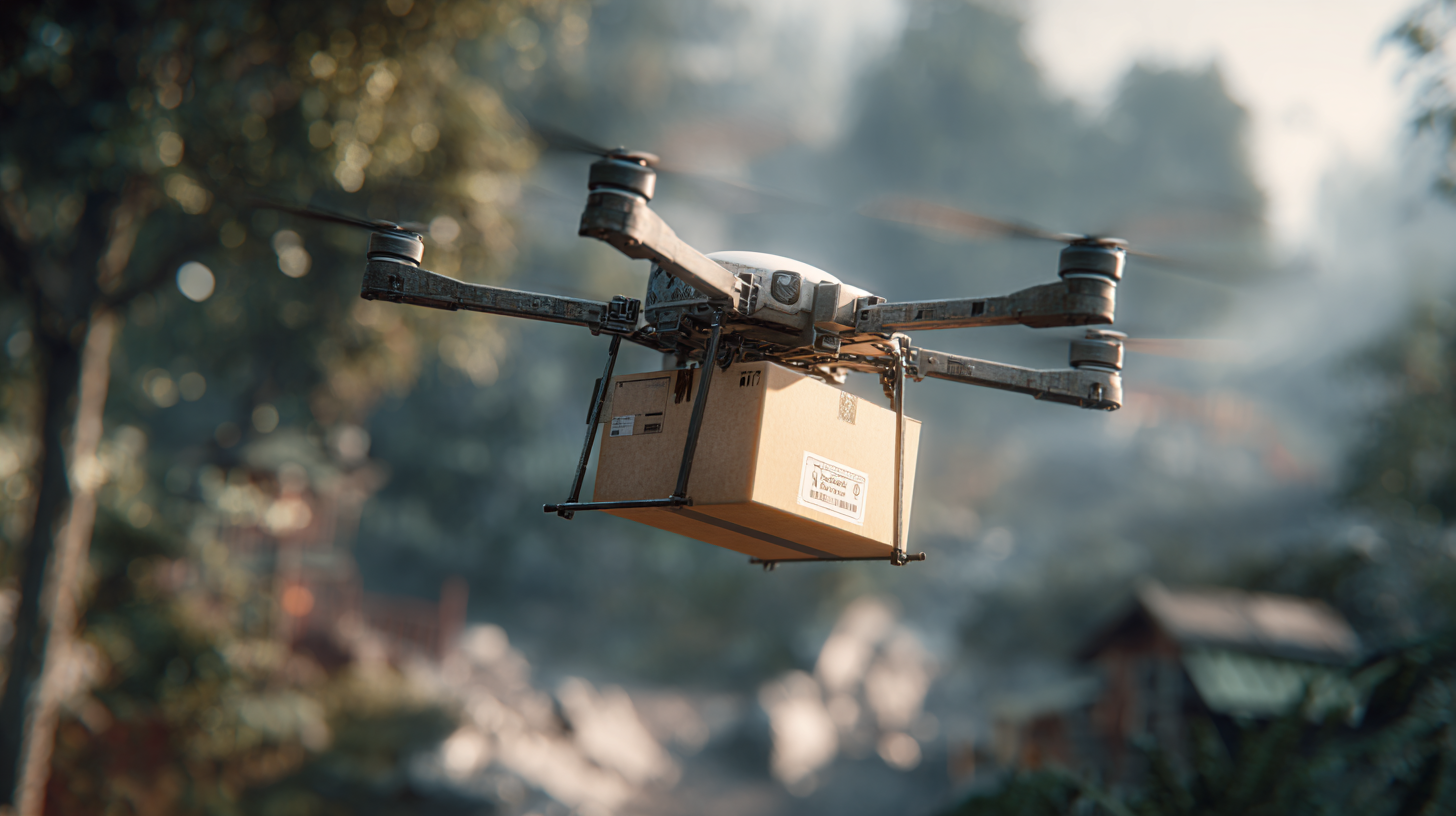
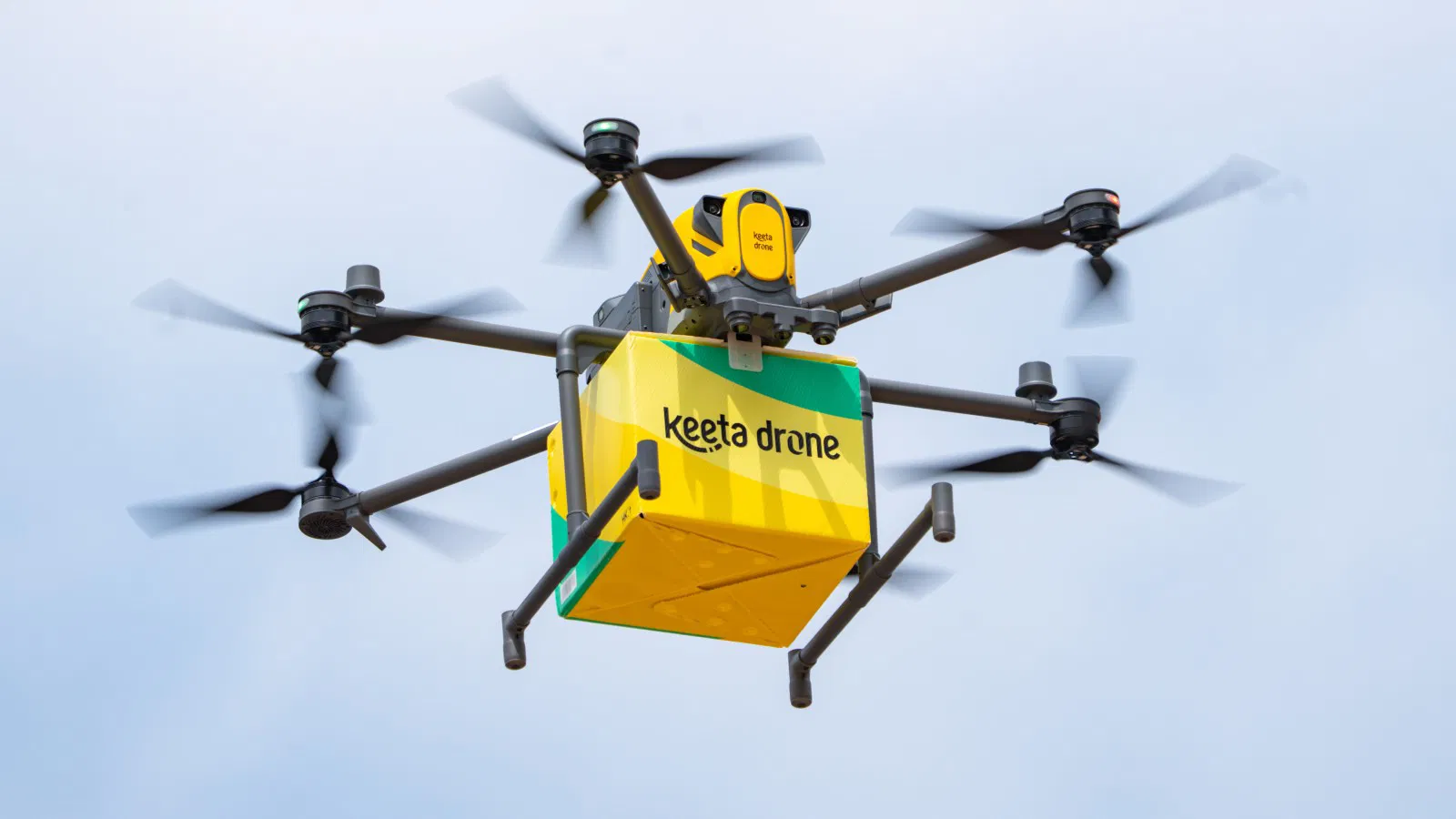
Drone deliveries in China date back to 2014 and now provide a host of practical uses, both consumer and commercial. Keeta Drone, an autonomous delivery company, operates more than 53 routes in major Chinese cities. Everything is tracked via smartphone. The drone lands at a designated station that works like a vending machine, with contents sealed in recyclable boxes. Customers enter a code to retrieve their delivery and recycle the box in an adjacent bin.
Recently, influencer IShowSpeed published a now viral video ordering KFC in Shenzhen's Talent Park using a drone delivery service from Meituan, with the delivery taking only minutes. This led many viewers to claim that China is "living in the future."
Today, China has drone services for everything from food deliveries to commercial construction equipment and emergency response. EHang, a global leader in intelligent autonomous aerial vehicle technology, is conducting pilotless air taxi trial flights in Guangzhou and other cities in South China, while its Shenzhen neighbor, Phoenix Wings, focuses on cargo drone operations across Guangdong province.
Despite the sector's impressive growth, this remains modest compared to traditional logistics. Even at roughly 1,000 drone flights per day, a figure reported by Channel News Asia, Shenzhen's aerial deliveries remain a fraction of conventional e-commerce traffic, a reminder that the global drone economy is still in its early phase. A report published by the Shenzhen Daily says the city achieved a milestone in drone deliveries in 2023, surpassing 600,000 flights. It also opened 77 new routes and established 73 new landing and takeoff points for unmanned aerial vehicles.
Worldwide, there were about 5 million business-to-consumer drone deliveries in 2024, an average of 14,000 per day. This number is projected to rise within the decade to 808 million, with the total value of goods delivered to consumers by drones expected to grow 74% annually, reaching $65.2 billion in 2034 from just over $251 million in 2024, according to PwC’s report Drone Deliveries: Taking Retail and Logistics to New Heights.
For years, Zipline's zero-emission autonomous drones have provided a literal lifeline to people in countries from England to Ghana and Zambia, where they regularly deliver agricultural products, blood, and medical supplies.
Source: YouTube / Zipline
Manna Drone Delivery has been delivering food across Ireland since 2018. With a $30 million funding round this year, the startup is expanding across Europe and aims to ramp up deliveries to an annual rate of over 1.5 million this year, founder Bobby Healy told Forbes.
Source: YouTube / Manna Drone Delivery
In Australia, Wing began its partnership with DoorDash in 2022 to pilot drone deliveries, and the collaboration has since expanded to additional suburbs, including parts of Melbourne.
Source: YouTube / Wing
With unit economics estimating delivery costs around $2 by 2034, PwC’s report notes that unmanned aerial systems offer an enticing alternative for businesses to enhance customer satisfaction and boost profitability, particularly in areas where traditional last-mile deliveries struggle.
Commercial drones represent a massive economic opportunity. So why aren't more flying in America?
Last August, U.S. Transportation Secretary Sean Duffy unveiled President Trump's plan, promising to eliminate cumbersome waiver requirements and significantly expand use cases for drone technologies in manufacturing, farming, energy production, filmmaking, and medical deliveries, according to a Department of Transportation announcement.
U.S. companies are already experimenting with drone delivery for home deliveries. Logistics startup DroneUp, based in Virginia, is piloting drone service delivery for Walmart, 7-Eleven, and Chick-fil-A in Florida and Texas. Amazon Prime Air currently operates drone delivery services in Texas and Arizona, offering deliveries in under an hour for thousands of everyday items, according to Amazon. Wing has expanded its DoorDash partnership to deliver to areas in Virginia, North Carolina, and Texas. And Zipline delivers for Panera Bread and Jet's Pizza. Expanding these kinds of drone delivery services across the United States, however, will be challenging.
The FAA requires most commercial drones to remain within the visual line of sight of the operator, limiting commercial applications. While the agency has recently increased waivers and proposed new rules to enable broader operations, the regulatory framework remains restrictive compared to China's more centralized, coordinated approach.
Beyond regulation, infrastructure gaps persist. Drone flights over populated areas carry greater safety risks, with fewer safe landing zones or drop-off points. Building the needed infrastructure is challenging enough, and rooftops only add to that complexity.
The larger challenge, however, may be U.S. restrictions on Chinese drone imports, which currently outpace domestic models in features, capabilities, and cost. Although American production is improving, it still trails technologically. Partnering with DJI or importing Chinese drones would be logical from a business standpoint, but federal policy now limits their use over national security concerns.
Large-scale drone deployment would also require stable, high-speed communications networks for command, control, and data transmission. China is leading the world in 5G and 5G-Advanced network construction, with coverage now reaching more than 300 cities, according to data cited by China’s Ministry of Industry and Information Technology. In the United States, rural areas still trail urban regions in broadband access, the FCC reports. The FCC’s $9 billion Rural 5G Fund, announced in 2020 to expand next-generation wireless access in underserved areas, was delayed while the agency improved coverage maps and has been moving forward toward implementation, according to the FCC.
The U.S. government’s Unleashing American Drone Dominance initiative marks meaningful progress in national drone policy. But when compared to China’s coordinated low-altitude economy agenda, large-scale, state-led infrastructure investments at the same breadth and depth are still relatively uncommon in the United States.
China is centrally coordinating and investing in telecommunications networks, urban air systems, and regulatory frameworks at the national scale. The investments reflect a commitment to infrastructure development and policy that the United States hasn't pursued in decades. One might conclude that China's relentless pursuit of excellence is a matter, it seems, of national prestige and technological leadership beyond economic returns; it's cultural. It also signals a willingness to build futuristic infrastructure that serves commerce and citizens alike, lifting both up. In this case, quite literally.