Comau Unveils Lighter MATE-XT GO Exoskeleton for Industrial Use

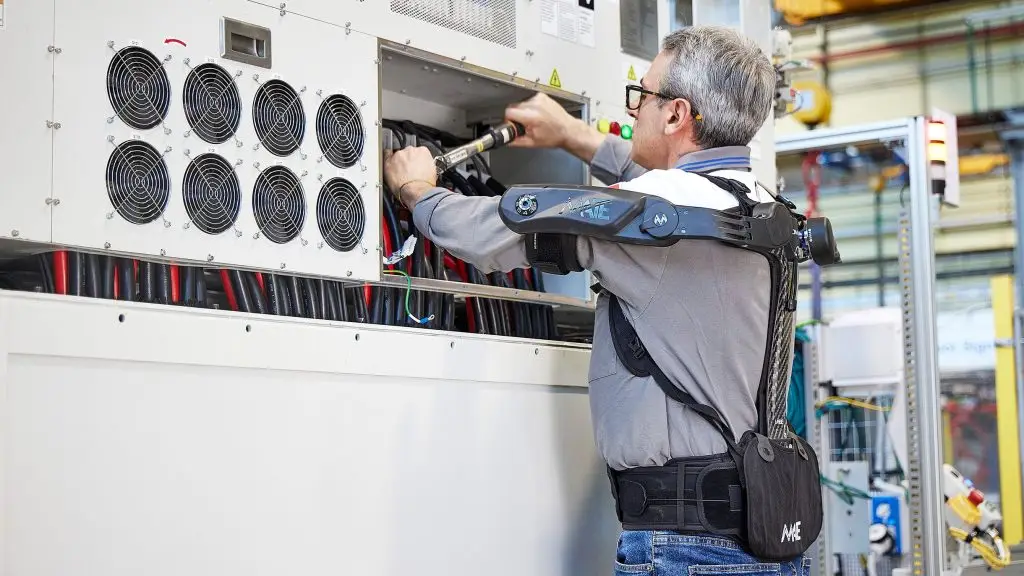
- The new MATE-XT GO exoskeleton reduces muscle activity and perceived effort by up to 50% during repetitive and overhead tasks.
- Weighing less than 3 kg and certified as Category II Personal Protective Equipment, it is designed for use in regulated professional environments.
Comau has introduced MATE-XT GO, a new wearable exoskeleton designed to support workers’ arms and shoulders during repetitive and overhead tasks. The device reduces muscle and perceived effort, helping improve comfort and endurance throughout the workday. Certified as Category II Personal Protective Equipment under EU Regulation 2016/425, it is approved for use in regulated professional environments.
MATE-XT GO weighs less than 3 kg and can be put on in 30 seconds and removed in 10 seconds, allowing easy integration into daily activities without interrupting workflows. Comau says the system reduces muscle activity and perceived effort by up to 50%, while preserving natural movement and posture. It provides eight adjustable levels of assistance for both arms, following the physiological movement of the shoulder. Its fully passive design requires minimal maintenance and lower lifecycle costs.
“This achievement marks an important step forward in our vision of human-centric automation. Building on the real-world experience of more than 3,000 companies already using MATE exoskeletons at international level, and by listening closely to the needs of both workers and employers, we have further evolved the technology to deliver measurable, everyday benefits,” said Marco Manavello, Chief Industrials Operations Officer, in a press release.
The exoskeleton is aimed at manufacturing, logistics, construction, agriculture, and skilled trades, and is positioned for both large enterprises and small and medium-sized businesses. Developed in collaboration with IUVO, MATE-XT GO builds on the existing MATE range with a lighter solution that is more economically accessible and well-suited for large-scale deployment.
🌀 Tom’s Take:
Exoskeletons like this are critical because they sit at the intersection of labor shortages and worker safety. As tasks stay physically demanding and workforces age, companies need practical tools that reduce strain without slowing operations. Wearable support systems are becoming a realistic way to protect people while sustaining output.
Source: Comau